Requisition to Tracking: Benefits of a Procurement Tracking Software

Procurement is a crucial function in any organization, and managing the process can be complex and time-consuming. From creating requisitions to tracking orders and payments, numerous, often tedious steps are involved in the purchasing process that requires careful coordination and management. 

The requisition serves as the initial request for goods or services, and the tracking of the requisition ensures that the procurement process is efficient, transparent, and compliant with internal policies and external regulations.

Fortunately, procurement tracking software can simplify the procurement process and give organizations greater visibility and control over their procurement activities. 

From improving efficiency to enhancing collaboration and data analysis, let’s explore the many advantages of procurement tracking software and why it is becoming an essential tool for modern procurement professionals.

Benefits of a Procurement Tracking Software

Procurement tracking software can significantly enhance the efficiency of procurement procedures by automating them, making it a valuable tool for your organization. Below are some advantages of utilizing this software: 

  1. Enhanced Efficiency

Procurement tracking software can automate your organization’s procurement processes, streamline them and reduce the likelihood of errors, delays, and manual input mistakes. This can save time and resources for organizations and improve efficiency. 

Bellwether’s digital procurement software can provide real-time insights into processes and track procurement metrics, such as lead times, delivery times, and supplier performance. For example, if there is a delay in supplier delivery times, our software can highlight this issue, allowing organizations to take action to address it. This can help your organization optimize its procurement operations, reduce costs, and identify areas for improvement. 

  1. Better Control

Procurement tracking software provides a centralized location for tracking all procurement activities, making it easier to monitor spending, manage contracts, and track supplier performance. It also makes it easier to manage contracts and track supplier performance. 

The software should be able to track contract milestones, such as expiration dates and renewal dates, and alert procurement teams when contracts are due for renewal. If the software can track supplier performance metrics, such as on-time delivery and product quality, and alert procurement teams when supplier performance falls below certain thresholds, then it is the software to choose. 

  1. Cost Savings

With better control and automation, procurement tracking software can help organizations identify cost-saving opportunities, negotiate better pricing with suppliers, and reduce overall procurement costs. 

By providing real-time insights into procurement metrics, such as spending and supplier performance, the software can help organizations optimize their procurement operations and reduce overall procurement costs. With Bellwether’s digital software, your organization can achieve better procurement efficiencies and drive better business outcomes. 

  1. Improved Transparency

Good procurement tracking software enables organizations to achieve greater visibility and transparency in their procurement processes, reducing the risk of fraudulent activities and ensuring compliance with regulations. Efficient tracking software will allow for real-time monitoring of procurement activities in your company, making it easier to track and analyze procurement spend, supplier performance, and contract management. 

With a more transparent procurement process, your company can easily prevent fraudulent activities and ensure compliance with regulatory requirements, ultimately leading to greater trust and credibility with stakeholders.

  1. Real-Time Reporting

Efficient procurement tracking software can enable your organization to generate real-time reports on procurement activities, providing valuable insights into spending patterns, supplier performance, and overall procurement effectiveness. Similarly, Bellwether’s procurement software will allow your organization to easily access and analyze data from different procurement activities, enabling you to identify trends, opportunities for improvement, and potential risks. 

By using the insights gained from Bellwether’s software, your company can make more informed decisions and optimize its procurement operations, leading to better procurement efficiencies and cost savings. Overall, real-time reporting capabilities provided by effective tracking software can enable your organization to improve its spend management capabilities. 

  1. Enhanced Collaboration

Improved collaboration and communication are key benefits of procurement tracking software, which provides a centralized platform for tracking procurement activities. By facilitating communication between procurement teams and other departments, the software ensures everyone is on the same page and working towards the same goals. 

This collaboration also reduces the risk of errors and delays within your organization, as all stakeholders have visibility into the procurement process and can provide input as needed. With improved collaboration, your procurement teams can optimize procurement processes and maximize bottom-line profits. 

  1. Increased Accountability

By offering an audit trail of every procurement activity, procurement tracking software promotes accountability among procurement professionals within your company. This, in turn, mitigates the risk of fraudulent practices and guarantees that all procurement procedures are executed according to internal guidelines and external regulations. 

Conclusion

In conclusion, procurement tracking software is a valuable tool for organizations seeking to streamline procurement processes and achieve greater efficiencies. It enables better control, promotes collaboration between departments, and provides real-time insights for cost savings and optimized processes. 

Creating a requisition and tracking it throughout the procurement process is vital for effective procurement management. It helps to improve communication, accuracy, control, efficiency, and compliance, ensuring that the procurement process is transparent, auditable, and meets all regulatory requirements.

With the ability to generate reports and enhance visibility, Bellwether’s software will help your organization reduce costs, negotiate better deals, and improve procurement operations overall. Bellwether’s digital procurement tracking software is a powerful tool that can help your organization to achieve its procurement goals seamlessly.  

Get a quick demo to watch it in action!


source https://www.bellwethercorp.com/blog/benefits-of-a-procurement-tracking-software/
How to Pick the Right Purchase Order Software

Why do I need Purchase Order Software? 

  • To Replace Manual handling of purchase orders 
  • To Avoid POs getting lost or misplaced
  • To Avoid delays in the Approval Process
  • To Utilize 2-day and 3-way matching
  • To Take advantage of Tracking & Reporting tools

It is essential that you pick the right purchasing software to simplify and streamline your workflow saving you both time and money.

As your business grows and your procurement needs become more complex, managing purchase orders can quickly become overwhelming. Picking a PO management software that offers a centralized platform will reduce your hassles and headaches in all steps of the process.

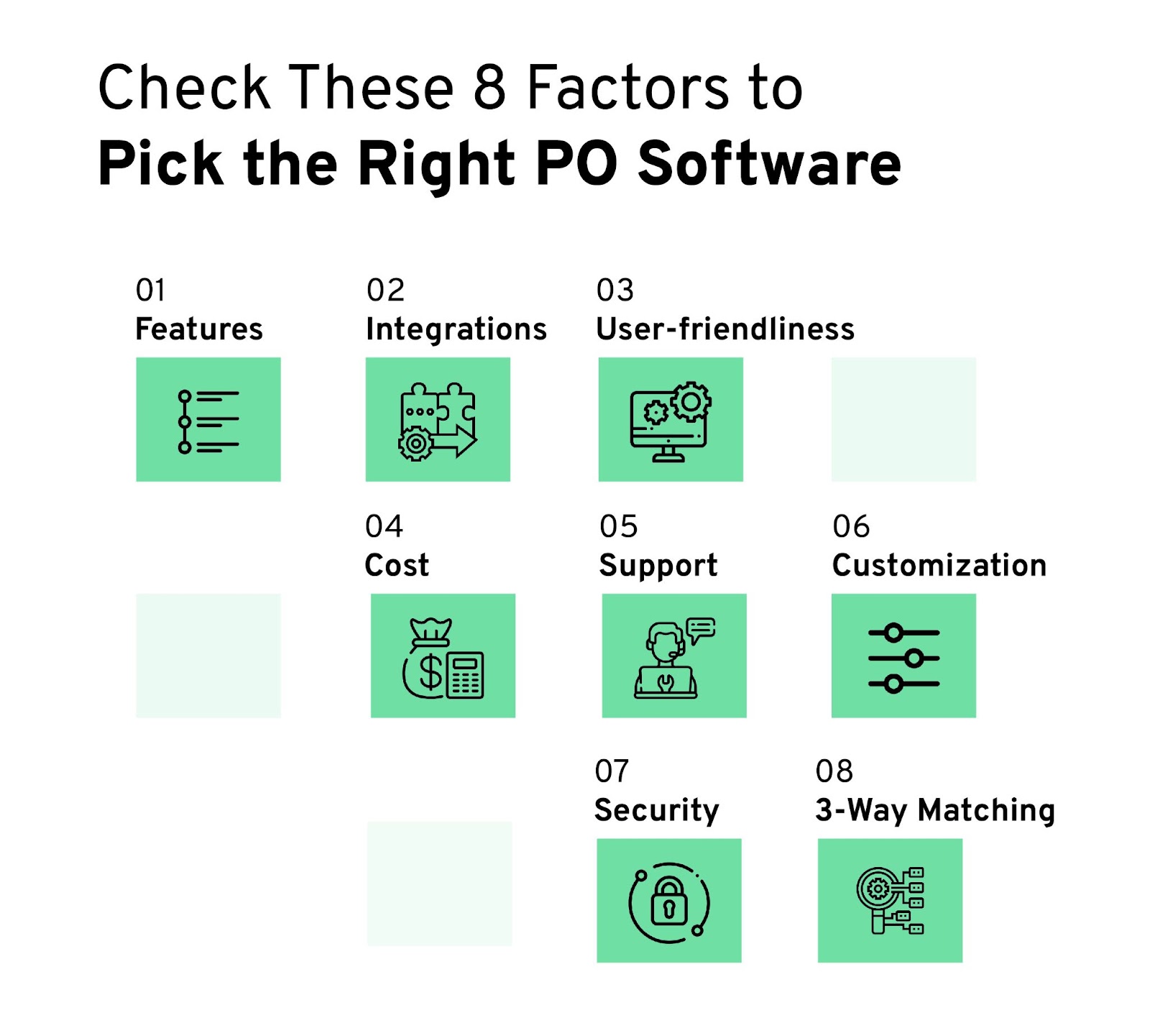
However, with so many available options, it can be challenging to pick the right system for your needs. Here are a few key factors to consider in your search for the ideal solution. 

  1. Features offered

One of the most important factors is the type of features offered such as customizable purchase order templates, automated approval workflows, supplier management tools, inventory controls, and contract management. 

Additionally, you can also consider whether the software offers advanced features such as asset management or financial integration to streamline the procurement process.

  1. Integration

Another essential consideration is how the software integrates with your organization’s existing systems. Integration is critical because it ensures that the PO management software works seamlessly with your other systems, such as accounting or inventory management software. Always look for software that offers integration with your existing systems to avoid the need for manual data entry and to streamline the procurement process.

  1. User-friendliness

Selecting software that is user-friendly and has a straightforward interface is critical to ensuring that your team can quickly adapt to the new system. If the software is user-friendly, it is easy to navigate the software, whether it offers intuitive tools for creating and managing purchase orders, or whether it offers a mobile application for access on the go – user-friendliness matters! 

  1. 3-Way Matching

A 3-way matching of important documents like purchase orders, goods receipts notes (GRN) and the supplier’s invoice is crucial to your company. This helps to detect discrepancies, if any, and eliminates fraud which increases efficiencies. If the PO software you choose is capable of seamlessly conducting a 3-way match of these documents, then you have made the right choice. 

  1. Customization

Every business has unique procurement processes, so it’s essential to look for software that allows for customization. If the software you choose allows you to add custom fields, configure the approval workflow to match your business processes, or customize the purchase order template to reflect your branding, then you have made the right decision for your organization. 

  1. Security

It’s crucial to ensure that the purchase order management software provides adequate security measures to protect sensitive information. When searching for purchase order management software, it’s important to seek out solutions that provide measures such as data encryption and user access controls, which can prevent unauthorized access to supplier information and purchase orders. 

Additionally, consider whether the software offers features such as audit trails to track changes made to purchase orders and ensure accountability.

  1. Cost

The cost of software is an essential factor to consider when selecting PO management software. You need to consider whether the software’s cost aligns with your organization’s budget, whether it offers a free trial period to test the software before committing to a subscription, and whether there are any associated fees, such as implementation or training costs.

  1. Support

Finally, it’s essential to consider the support offered by the PO management software provider. Your company needs to look for software that provides reliable customer support and resources, such as user manuals or training materials, to ensure that your team can effectively use the software. Further, consider whether the software provider offers technical support, whether there is a dedicated account manager, and what the provider’s response time is for resolving issues for your company. 

In summary, selecting the right software for purchase order management involves considering factors such as features, 3-way matching, integration, user-friendliness, customization, security, cost, and support. By carefully evaluating these factors, businesses can choose a software solution that aligns with their procurement needs and goals, streamlines the procurement process, and ultimately saves time and money. 

Bellwether’s procurement software can do all of the above and much more. Contact us. 


source https://www.bellwethercorp.com/blog/how-to-pick-the-right-purchase-order-software/

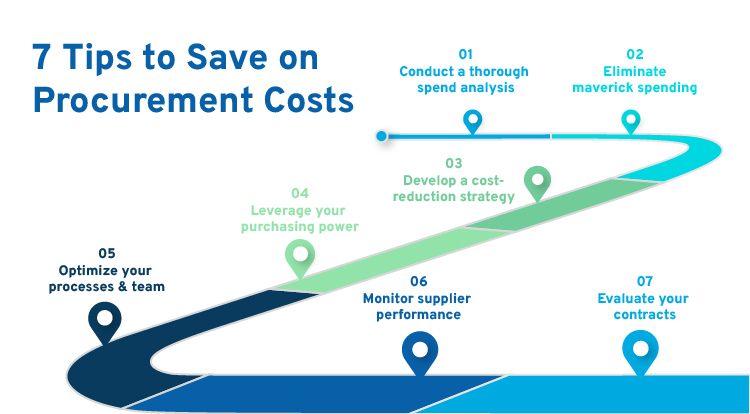
7 Tips for Procurement Cost Savings 

Procurement cost savings is a crucial aspect of any business operation as it helps reduce expenses and increase profitability. Efficient procurement practices can significantly impact the bottom line of a business by reducing the cost of goods and services. To achieve procurement cost savings, businesses need to implement strategies that focus on reducing expenses while maintaining quality. 

Let’s have a look at how the tips below can improve your company’s financial health and competitiveness. These tips, when implemented effectively, can help businesses achieve significant cost savings in procurement. 

7 Tips for Procurement Cost Savings

The reasons your organization needs to consider procurement cost savings are simple. Organizations that are able to achieve procurement cost savings can offer their products or services at a more competitive price. This gives them an advantage over their competitors and helps them win new business. Here are some tips on how your organization can save costs: 

  1. Conduct a thorough spend analysis 

Analyzing your procurement data to identify areas where you can reduce costs will prove to be highly effective. This will help your company identify the categories that consume the largest percentage of your budget. 

By understanding which categories consume the largest percentage of the budget and identifying inefficiencies in the procurement process, your company can take targeted actions to improve efficiency, reduce costs, and improve its bottom line.

  1. Eliminate maverick spending 

By eliminating maverick spending, your organizations can reduce the risk of budget overruns, improve financial accountability, and ensure that all resources are used in a strategic and effective manner. This way, your business will experience visible bottom-line profits as there is a reduction in unauthorized spending. 

  1. Develop a cost-reduction strategy

Developing a comprehensive cost-reduction strategy to achieve your cost savings goals is essential. This strategy should prioritize the most significant cost savings opportunities in your organization and include specific targets and timelines. 

By prioritizing the most significant cost savings opportunities, setting specific targets and timelines, and taking certain actions to achieve those goals, your organization can easily reduce costs, improve efficiency, and achieve its financial objectives. 

  1. Leverage your purchasing power

It is crucial that your organization uses its purchasing power to negotiate better deals with suppliers. To reduce costs, your company can consolidate the supplier base to reduce the number of suppliers they deal with and increase your leverage in negotiations. 

By focusing on a smaller number of suppliers, your organization can develop deeper relationships and better understand the supplier’s capabilities, enabling it to negotiate better deals based on volume discounts, improved payment terms, or other incentives.

  1. Optimize your procurement processes & train your team

By optimizing your procurement processes, your company can seamlessly reduce the time and resources required to complete them. Using technology to automate repetitive tasks and streamline workflows is paramount.

Additionally, training your procurement team to become more efficient in procurement activities, such as negotiating with suppliers, tracking inventory, and managing contracts will also help in saving costs and increasing efficiencies in your organization. 

  1. Monitor supplier performance

Monitoring your supplier’s performance to ensure that they are meeting their contractual obligations and delivering the expected quality at the agreed-upon price is essential. 

By investing the time and resources to establish a robust monitoring system, you can maintain a strong and productive relationship with your suppliers and minimize the risk of costly disruptions to your business operations.

  1. Evaluate your contracts 

Evaluating your contracts regularly is an essential step in ensuring that you are getting the best possible value from your suppliers. By reviewing your contracts, you can identify areas where you may be able to renegotiate terms and achieve cost savings. 

When renegotiating contracts, it’s important to approach the process in a collaborative and transparent manner. In addition to achieving cost savings, renegotiating contracts can also help you improve the quality of goods or services you receive. 

Conclusion

In conclusion, implementing these seven tips for procurement cost savings can help organizations of all sizes optimize their purchasing processes and reduce costs. By taking a strategic and data-driven approach to procurement, companies can improve their bottom line and achieve greater efficiency in their operations. 

Whether it’s negotiating better contracts, leveraging technology to streamline processes, or optimizing supply chain logistics, there are a variety of approaches that organizations can take to achieve significant cost savings. 

By prioritizing cost savings in procurement, companies can not only reduce costs but also gain a competitive advantage in their respective industries. By adopting these tips and continuously refining their procurement strategies, organizations can build a more sustainable and profitable business in the long term.

Bellwether’s digital procurement software can help your organization achieve significant cost savings by eliminating maverick spending, streamlining your purchasing process, automating contract management, and providing advanced analytics. By adopting this software, organizations can build a more efficient and cost-effective procurement process, ultimately leading to a more sustainable and profitable business. 

Contact us to book a demo! 


source https://www.bellwethercorp.com/blog/7-tips-for-procurement-cost-savings/

How to Control Spending Using Purchase Order Processing Software

Controlling spending is a critical aspect of managing any business, and it can be particularly challenging to keep spending in check when purchasing goods and services. One way to manage spending in this area is to implement purchase order processing software, which can streamline the purchase order (PO) process, reduce errors, and increase efficiency within your organization. 

With the right approach, businesses can use purchase order processing software to set spending limits, monitor purchases in real-time, and track inventory levels, all of which can help to keep spending under control. 

Let’s have a look at ways in which your organization can control spending using efficient PO processing software.

How to control spending using PO processing software?

Purchase order processing software can help your business automate and manage its purchase order workflows. Purchase orders are documents issued by a buyer to a supplier, outlining the details of the goods or services to be purchased, including the quantities, prices, delivery dates, and other important terms and conditions. 

A purchase order processing software can simplify your company’s PO process by allowing your business to create, approve, and manage purchase orders electronically, rather than using paper-based systems. 

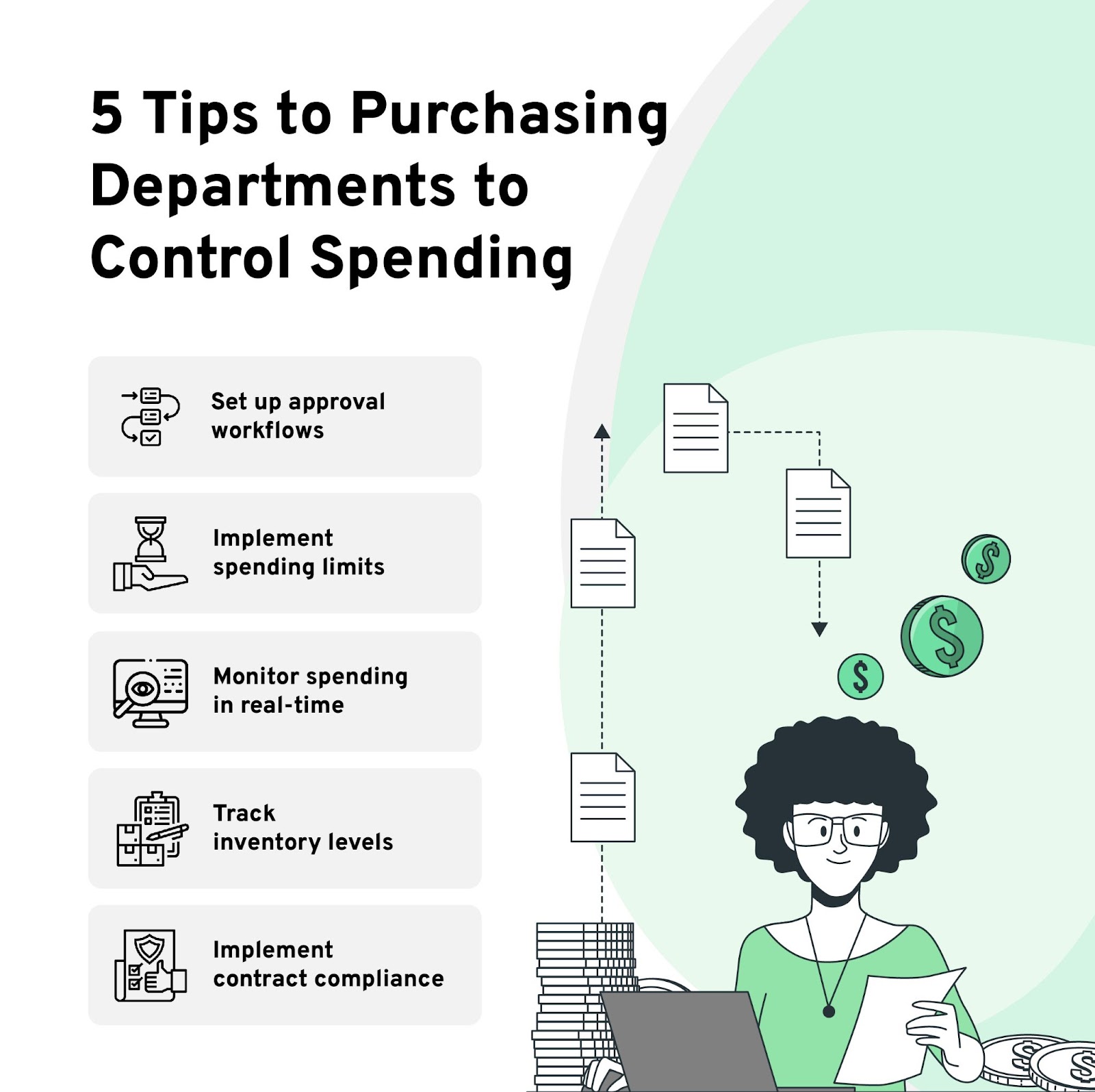
PO processing software can help your organization to control its spending in several ways. Here are some tips on how to use purchase order processing software to control spending in your company:

  1. Set up approval workflows 

Purchase order processing software allows you to set up approval workflows, which means that all POs must be approved by designated individuals before they can be processed. This helps to prevent unauthorized purchases in your company and ensures that all purchases are necessary and within budget.

  1. Implement spending limits

You can set up spending limits within your PO processing software. This ensures that employees of your company can only make purchases up to a certain amount without needing additional approval. This can help to prevent overspending and keep purchases within budget.

  1. Monitor spending in real-time

With this software, you can monitor spending in real-time, which means you can quickly identify any unexpected or unnecessary purchases in your organization. This enables you to take action to stop any excessive spending before it becomes a significant problem for the business.

  1. Track inventory levels

PO processing software allows you to track inventory levels, which can help you to avoid overstocking and reduce unnecessary purchases. By knowing the inventory levels in your company, you can adjust purchasing to meet actual demands.

  1. Implement contract compliance

You can implement contract compliance within this software, which means that all purchases must be made with authorized vendors of your business at pre-agreed prices. This can help to prevent overspending and ensure that purchases are made at the best possible price. 

By implementing these tips, your organization can use such software to control your spending, reduce costs, and make more informed purchasing decisions to increase bottom-line profits. This can also help your company to improve purchasing efficiency and increase visibility into spending activity. 

Importance of PO processing software

Businesses of all sizes have realized that it is increasingly important to implement automated PO processing software. Here are some of the key benefits and importance of using purchase order processing software

  1. Streamlined purchasing process

PO processing software automates the entire purchasing process, including the creation, approval, and tracking of purchase orders. This reduces the amount of manual work required to manage purchases and ensures that the processes in your company are consistent and standardized.

  1. Enhanced visibility 

This software can provide your organization with real-time visibility into its purchasing activity, including spending patterns, inventory levels, and supplier performance. This will allow your business to make more informed decisions and identify opportunities to reduce costs.

  1. Better cost control

An automated PO processing software enables businesses to set spending limits, control inventory levels, and ensure that purchases are made at pre-agreed prices. This can help your organization to prevent overspending and ensure purchases are made within budget. 

  1. Better compliance

This software can help your business comply with procurement regulations, including those related to vendor selection, contract terms, and internal controls.

In conclusion, purchase order processing software can be a powerful tool for controlling spending in your business. Automating the purchasing process and providing greater visibility into spending, can help reduce errors, prevent overspending, and ensure that purchases align with your company policies and goals. 

Once the policies and procedures are in place, businesses should choose a purchase order processing software that meets their specific needs. Overall, with the right policies, procedures, and software in place, businesses can use purchase order processing to take control of their spending and drive greater efficiency and cost savings. 

Contact us or Schedule a demo to get the best out of Bellwether’s procurement software! 


source https://www.bellwethercorp.com/blog/how-to-control-spending-using-purchase-order-processing-software/

Purchase Order vs. Invoice: And Why You Need Both

For any organization, purchase orders (POs) and invoices are two critical documents that serve different purposes. While purchase orders are used to initiate and manage orders with suppliers, invoices are used to request payment for goods or services provided.

Businesses need both documents to manage their procurement functions and processes effectively. Let’s look at the difference between them and illustrate why both are crucial in streamlining your workflows. 

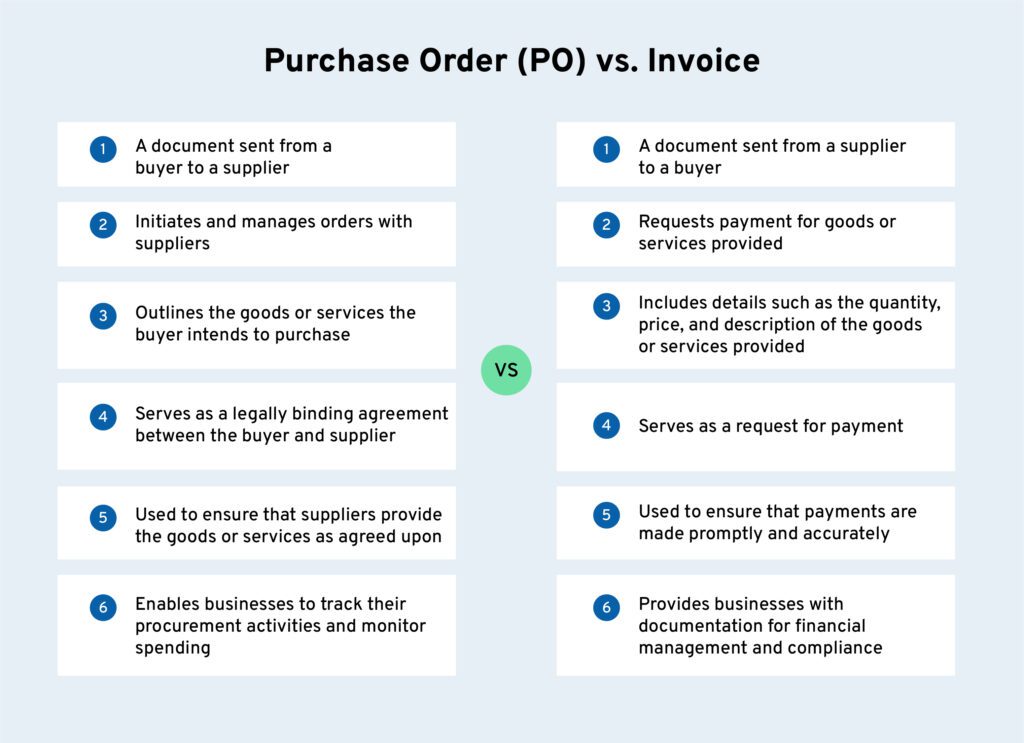
Purchase Order vs Invoice

Let’s have a clear understanding of what is a PO and an invoice, what is the difference between the two and yet, why they are both equally essential for your business. 

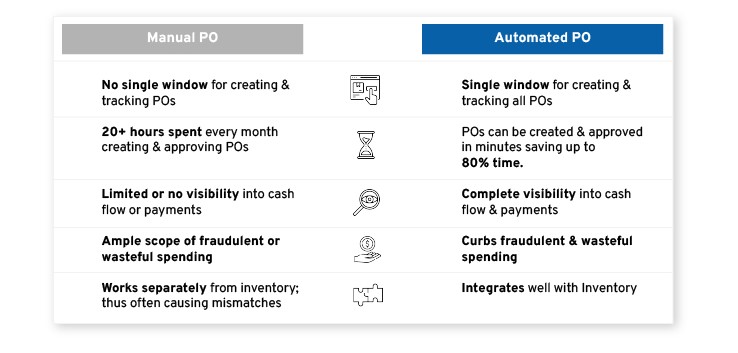
But before we jump into that, it is worth noting that we will be mostly covering them in the context of automated systems. If you don’t know much about the differences between manual and automated systems, here’s a quick primer: 

Manual PO vs. Automated PO

What is a Purchase Order?

A purchase order is a document sent from a buyer to a supplier that outlines the goods or services the buyer intends to purchase. It includes details such as the vendor, ship-to code, delivery date, quantity, and price. A PO is used to initiate and manage orders with suppliers and serves as a legally binding agreement between the buyer and supplier.


What is an Invoice?

On the other hand, an invoice is a document sent from a supplier to a buyer requesting payment for goods or services that have been provided. An invoice typically includes additional details such as packing slip, invoice date, taxes, and freight. It serves as a request for payment and includes payment terms such as the due date and accepted payment methods.

Below Is an overview of the key differences between a PO and an Invoice. 


Similarities Between Purchase Orders & Invoices

While purchase orders (POs) and invoices serve different purposes in the procurement process, they do share some similarities.  

  1. Purchase orders and invoices both include information about the items being bought, such as the quantity, price, and description.
  2. Purchase orders and invoices both provide businesses with documentation for financial management and compliance. 
  3. Both documents enable businesses to track their procurement activities, monitor spending, and ensure that procurement activities are conducted in a compliant and ethical manner. 
  4. Finally, both these documents are legally binding. 


Why do you need both Purchase Orders and Invoices?

Purchase orders and invoices are both critical to the procurement process in your organization, and you need both to manage procurement effectively. Here are some reasons why:

  1. Purchase orders help manage orders

POs are used to initiate and manage orders with suppliers. They provide clear instructions to your suppliers about the goods or services that are required, the quantity, and delivery details. POs also enable your buyers to track orders and ensure that they are fulfilled as per the agreed-upon terms.

  1. Invoices ensure accurate payment 

Invoices are used to request payment for goods or services provided. They provide a detailed breakdown of the goods or services provided, the quantity, price, and payment terms. Invoices help ensure that your buyer is paying the correct amount for the goods or services received, and they also enable the buyer to reconcile their accounts payable records.

  1. POs and invoices help manage cash flow

By using both POs and invoices together, your company can manage its cash flow more effectively. POs allow your buyers to forecast their future cash requirements accurately, while invoices provide a clear record of the payments that need to be made.

  1. Purchase orders and invoices help manage relationships

POs and invoices are important tools for managing relationships with your suppliers. By using POs, buyers can ensure that suppliers are fulfilling their orders as per the agreed-upon terms, while invoices enable suppliers to request timely payments for the goods or services they have provided.


Conclusion

In conclusion, POs and invoices are requisite for every organization. They are two key documents in the procurement process that are necessary for the smooth functioning of procurement activities in your organization. 

By understanding the differences and similarities between purchase orders and invoices, businesses can effectively manage their procurement activities and ensure that payments are made accurately and promptly. 

With Bellwether’s procurement software, you’ll enjoy a complete procure-to-pay (P2P) package which makes it easy to create a PO and raise an invoice to finally complete your purchasing process. Make your procurement journey seamless and efficient with Bellwether. Contact us.

source https://www.bellwethercorp.com/blog/purchase-order-vs-invoice-effective-procurement/

8 Barriers to Procure-to-Pay (P2P) Automation

Procure-to-pay (P2P) automation is the use of technology to streamline and optimize the procurement process – from purchase order creation to vendor payment and everything in between. When your company has implemented a software that supports P2P automation, you will automatically see increased efficiencies and an improvement in accuracy. 

In simple terms, P2P automation can automate manual, repetitive, and time-consuming tasks, freeing up resources and improving efficiency while reducing errors and ensuring data accuracy. This improves the quality of procurement decisions. Despite the many benefits of P2P automation, there can still be barriers to its implementation and successful adoption. 

Let’s have a look.

Barriers to Procure-to-Pay (P2P) Automation

Barriers to procure-to-pay (P2P) refer to any challenges or obstacles that hinder the smooth and efficient flow of goods and services from purchase to payment. Some common barriers include: 

  1. Lack of standardization

Most times in an organization, there are various departments that work together. Similarly, your organization might also have various departments working together and different departments might have varied processes. Independent departments and processes may have different requirements and procedures, leading to confusion and inefficiencies. This could be a major barrier. 

  1. Poor supplier management

Poor relationships with your suppliers, insufficient supplier information, or lack of supplier performance monitoring can lead to supply chain disruptions within your organization. This becomes a barrier and hence, it becomes essential to manage suppliers efficiently and maintain a healthy and long-lasting relationship with them. 

  1. Insufficient data

This is another major concern for any company. Incomplete or inaccurate data, such as incorrect vendor information or incorrect purchase order amounts, can slow down P2P processes in your organization and lead to unwanted errors.

  1. Ineffective communication

As there are multiple departments involved in a company, it is likely that there will be communication errors. Poor communication between departments, such as procurement, accounts payable, and finance, can lead to delays and errors in your organization’s P2P processes. 

  1. Resistance to change

It is a common norm that change is usually not easily accepted. The same might happen in your organization when you try to implement new processes and make changes to the existing, already-established traditional purchasing processes. Employees may resist changes to established P2P processes and may be unwilling to adopt new technologies or procedures. Employees may not fully understand how to use the new technology, leading to slow adoption and decreased efficiency.

  1. Lack of technology infrastructure

This barrier, unfortunately, is more common than we might think. A company may lack the necessary technology infrastructure, such as hardware, software, or internet connectivity, to support P2P automation. For start with, you need a robust procure-to-pay software to bridge the technological gap. 

  1. Budget and technological constraints

A company might not always be able to afford to automate its traditional procurement processes. They may face budget constraints, making it difficult to invest in P2P automation technology and services. Further, P2P automation may require integration with existing systems, such as ERP or accounting systems, which can be complex and time-consuming, making it a major barrier. 

  1. Lack of training and support

This could be a major barrier if companies do not provide sufficient training and support to employees. If there is no proper training, it will make it difficult for the employees to use the technology effectively and get the best out of it. 

In conclusion, while P2P automation offers many benefits to your company, there can still be barriers to its implementation and successful adoption. To overcome these barriers, your organization needs to adopt a strategic approach that includes planning, technology selection, employee training and support, data management, and continuous improvement. 

By addressing these barriers, your organization can successfully implement P2P automation and realize the many benefits of a streamlined and efficient procurement process. Bellwether’s procurement software can help with efficient P2P automation and overcome these barriers successfully.

If you are still running your requisition, approval, and other processes manually, request a demo to learn how Bellwether can help you automate it. 

source https://www.bellwethercorp.com/blog/8-barriers-to-procure-to-pay-p2p-automation/

What is Procure-to-Pay (P2P)? 

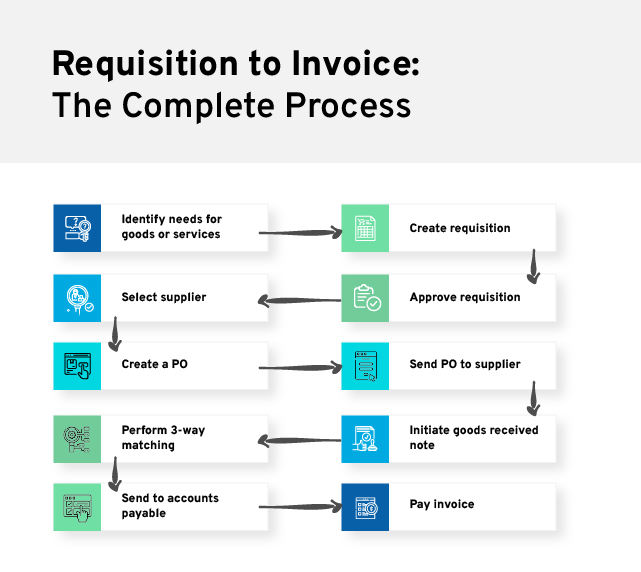
In simple terms, procure-to-pay (P2P) encompasses the entire journey from requisition to invoicing and everything in between including purchasing, receiving, paying and more. Just as the name suggests, the procure-to-pay cycle process begins with procuring the goods or services to finally paying for them. P2P is also often referred to as purchase-to-pay.

The Procure-to-Pay (P2P) Process

It goes without saying that the P2P process is more efficient when it is automated. The P2P process is complex without being automated and hence, most companies choose a procure-to-pay solution which can easily integrate into the existing processes. 

The P2P process can be customized as per every organization’s unique needs but here is what a general process looks like. 

Step 1: Need identification 

The very first step in the P2P process is to identify the needs. Determining and defining the needs of the business will always be the first step. Once this is done, the procurement teams sit together and brainstorm and plan out the specifications of the goods or services to be ordered. 

Step 2: Creating a requisition 

Once the needs are identified and the specifications of the goods or services are finalized, a formal purchase requisition is created. In this step, a requester submits a form i.e. a duly filled purchase requisition form to the purchasing department. The requester has to make sure all necessary administrative requirements are met while filling out the form. 

Step 3: Approval of the purchase requisition 

Once the requisition is created, it is submitted to the concerned departments and is reviewed by the department heads or purchasing managers. The approvers will evaluate the need and why the request was raised if it is within budget and then either approve or reject the purchase requisition form. If the submitted requisitions are incomplete, they are rejected and returned to the requester for resubmission. 

Step 4: Creating a Purchase Order (PO)

If the submitted requisition form was complete and satisfied the need and was within budget, it will be approved. Once approved, purchase orders can be created from these purchase requisitions and submitted for approval. 

P2P Process

Step 5: Approval of the purchase order

Once the PO is sent for approval, it is checked for the accuracy of the information provided on the order. Before approval, the POs pass through multiple approval levels. Once approved, the PO is submitted to the vendors and the vendors can either approve or reject the PO. They can even negotiate on this further. Once the PO is finally approved, it becomes a legally binding contract. 

Step 6: Receiving the goods 

The supplier has to then fulfill the order as per the PO. Once the goods are delivered, the buyer will inspect and check the goods if they are as per the contract terms. The goods receipt is either approved or rejected based on the contract terms and standards specified. 

Step 7: Analyzing the supplier’s performance

The supplier is evaluated based on the previous step. If the goods delivered by the supplier are up to the mark and meet all the quality specifications, the supplier’s performance is considered to be good. Quality, the time required to deliver the goods, compliance, etc. are factors to be taken into consideration while analyzing the supplier’s performance. 

Step 8: Approval of the invoice

Once the goods are received and approved, a three-way match is performed i.e. the purchase order, goods receipt and the invoice sent by the vendor are matched. If they match, they are then forwarded to the finance team for disbursement. 

Step 9: Releasing payment to the vendor

Once the invoice is approved by the finance team, the vendor will receive payment from the finance team as per the terms of the contract. This completes the purchase-to-pay (P2P) process. 

Conclusion

The P2P process helps organizations in improving efficiency and increases the overall bottom line of the company. The procurement process remains transparent which keeps maverick spending in check and this, in turn, streamlines processes and saves costs and time. 

source https://www.bellwethercorp.com/what-is-procure-to-pay-p2p/

7 Common Procurement Challenges all Purchasing Managers face (and how to solve them)

A purchasing manager (PM) is also called a procurement manager. The role of a purchasing manager is seldom taken seriously i.e. it is not given the importance it deserves. This, unfortunately, is a mistake which can cost an organization heavily. 

A procurement manager is someone who is responsible for sourcing products and services for their organization. A purchasing manager reports to a Chief Procurement Officer (CPO) in a large organization. Whereas, in a small or medium organization, the purchasing manager is often a department on its own.

In such a case, the procurement manager reports to either the Chief Operations Officer (COO) or the Chief Finance Officer (CFO). Irrespective of the size of the organization, procurement managers and their teams have to work closely with the finance, operations, and legal teams. 

The roles and responsibilities of a purchasing manager include making sure that their business purchases the goods and services that will best help them achieve their goals. The managers also have to review past purchases made by the company to determine vendor effectiveness, compliance, and return on investment (ROI). 

The procurement managers (PMs) have to ensure they strike a balance between quality and cost, to reach their business goals. However, there are certain challenges which all purchasing managers face. Let’s have a look at some challenges and understand how one can solve them.

7 common procurement challenges purchasing managers face

For most purchasing managers, the top priority has always been cost savings. But now, as the times are changing globally, new requirements in procurement and supply chain are surfacing and are bringing in new challenges with them. 

With changing responsibilities, the approach procurement managers have to take is diverting from the usual. Technological advancements are also rapidly changing the responsibilities of purchasing managers. Here are a few challenges they could face. 

  1. Managing and mitigating risk 

Earlier, spend management was considered to be a crucial job of a purchasing manager. However, while spend management is still important, managing risk and mitigating it at the right time is given more weight. This is because of the recent volatility in the global supply chain and procurement activities. Companies that adapt to supply chain volatility have the last laugh. 

How to solve this procurement challenge?

PMs need to do thorough supplier market research which helps them in gathering the right supplier intelligence and transparency. Knowing the risks of working with suppliers beforehand gives them wiggle room to prepare for contingencies and come up with a backup plan if required. 

One way of actively managing and mitigating risks is by diversifying an organization’s supplier base. Diversification will help in tackling purchasing issues such as supply shortages and delivery issues. However, diversification is no easy task and it needs to be backed by strong research of a company’s suppliers. 

  1. Implementation of digital technologies

Organizations that fail to implement digital purchasing software often end up with financial losses and bad partnerships. Hence, automated software is essential to capture accurate and critical data. Data accuracy can help purchasing managers make decisions that are crucial to a company’s purchasing efforts. 

How to solve this procurement challenge?

The primary reason why purchasing teams do not have access to digital procurement software is that their organization is too focused on cost-cutting in the wrong places. The costs associated with digitizing and automating their supply chains are too high. But, they are an investment towards bettering the company’s bottom-line profits. 

Most purchasing teams need to adapt to digital software as soon as possible to automate their purchasing processes. Technology is the key to future-proof a company’s growth and profitability. It also helps the organization see the bigger picture of how purchasing and procurement fit into the long-term goals of the organization. 

  1. Collecting accurate data and insights can be a challenge

Important data related to company inventory, contract renewals, market pricing, standing POs, and supplier KPIs provide crucial and valuable insight when purchasing. Purchasing managers need solid and reliable data to prevent purchasing issues like inventory shortages or excess to help keep a track of spending and contracts.

How to solve this procurement challenge?

Implementing an automated purchasing software can help PMs be in close contact with the right suppliers which will help them keep a track of inventory, and goods received, and manage spend accordingly. 

When purchasing teams can have access to such data points easily, the organization’s bottom-line profits grow. The company is at a lower risk of suffering any major financial loss or missing out on strategic opportunities. This dramatically reduces human errors and streamlines the entire purchasing process.  

  1. Unknowingly purchasing duplicate or excess items 

It is considered a common mistake in purchasing to order duplicate items or having more of an item than required. While this is a common mistake, it is one which needs to be avoided at all costs. 

Without an effective purchase order workflow, employees might place repeat orders or pay for services that have already been purchased. When such an incident happens, purchase managers find it hard to trace orders and determine what has exactly happened as this process lacks transparency. 

How to solve this procurement challenge?

The most important thing is to adopt a purchasing protocol which requires more than one approver. This ensures that there are multiple levels of approval which means increased transparency and efficiency. 

This will eliminate the challenge of ordering more of one item and reduce inefficiencies in the procurement workflow process, making it easier for procurement managers to keep track. Eventually, adopting digital procurement processes is what makes a difference.  

  1. Employees’ failure to purchase from preferred or approved vendors

This is most commonly found in large and fast-growing organizations that do not have a centralized database for supplier information. Without a centralized database, employees will purchase from vendors not previously approved by the company just to order what they need on time and to avoid delays. 

While this might sound like a quick fix and an easy solution, purchasing from unapproved vendors might cost more and may hamper relationships with existing strategic vendors. 

Hence, when your purchasing team is not ordering from pre-approved vendors, procurement managers face the problem of missing out on important business opportunities and this can prove to be risky. 

How to solve this procurement challenge?

The logical way to overcome this challenge is for the organization to use centralized and easily accessible vendor management or supplier management catalogue. This will provide purchasing managers and their teams with transparency that allows them to easily access vendor catalogues. 

This will allow for aligned purchasing, time and cost savings, increased negotiating power and most importantly, maintaining healthy relationships with strategic suppliers.  

  1. Implementing compliance

It is no secret that spend management policies are often difficult to implement within an organization because of the complexities involved. However, they are necessary as, without compliance rules and policies, the company becomes vulnerable to maverick spending, potential litigation, etc. With compliance and policies come supply chain transparency, sustainability, and risk mitigation. 

How to solve this procurement challenge?

A practical way to overcome this challenge would be for organizations to have a clear set of compliance rules for both internal and external partners such as vendors. This will not only protect the company from any fraud but also set a standard for every department on spending and performance of suppliers. 

Finally, digital purchasing software is the way to go for allowing purchase approval access for every department. 

  1. Optimizing the purchasing process

Purchasing managers play a crucial role in a company as they are responsible for knowing what the company needs and when, selecting the best offers from vendors, accepting deliveries, and processing payments. 

When a PM has to do all of the mentioned tasks manually, it makes the entire procurement process inefficient and leaves room for error and fraud. This manual process cuts a company’s growth and profitability. 

How to solve this procurement challenge?

Automating the entire purchasing process will save time and cut costs, reduce errors and maverick spending. With digital software, every step is recorded and provides transparency into the transaction to ensure unnecessary expenses are kept at bay. 

Procurement managers are responsible for running this purchasing process efficiently and digital procurement software can effectively streamline the entire process. Hence, PMs are tasked with finding the best possible solution. When they find one, there is no better way to take control of things and lead the companies on a path to success.

Conclusion

The role of purchasing managers is crucial when it comes to solving procurement challenges. They are the ones working closely with procurement teams and making important purchasing decisions for an organization. From making strategic sourcing decisions to maximizing savings opportunities, PMs have a lasting impact on the profitability and growth of their company. 

A procurement manager can turn purchasing challenges into a competitive advantage and provide their company with a competitive edge. This can be done by equipping the organization with the right strategies and tools, technology and data insights.

source https://www.bellwethercorp.com/7-common-procurement-challenges-all-purchasing-managers-face-and-solutions/

A Quick Guide to Purchase Order (PO) Terms and Conditions

A procurement process is incomplete without purchase orders (POs). They are crucial for the success of any business. A purchase order is a legal document created by a buyer and sent to the seller for purchase of goods or services. A PO is a document which is created by the buyer with an intention to purchase products or services from a seller. 

Once the PO is accepted by the seller, it becomes a legally binding contract that protects both the buyer and the seller. Since it is a legally binding document, a purchase order contains many fields namely – PO Number, quantity and type of items required, payment terms, delivery details, etc. 

The terms and conditions of a PO highlight the rights and obligations of the supplier and the buyer. All this together makes up the entire agreement of the purchase order. But first, we need to understand the purpose of an order and what goes into that order.

Purpose of a Purchase Order

Digital procurement is the norm today and purchase order is an integral part of any good purchasing software. POs are crucial to your business as they document the purchasing part of your inventory management system. Plus, they are a legally binding document. 

An order is a significant source of information. If you need to trace the path of a particular product i.e. right from the purchase of raw materials to the sale to the customer – the PO has it all. It is of paramount importance when it comes to transparency in your organization’s procure-to-pay (P2P) process. 

The procurement department or the purchasing manager in your organization issues a purchase order form or a PO letter to the supplier to authorize a purchase. An estimated cost of the goods to be purchased is documented in a quote which often precedes a purchase order. You can simply approve that quote using a PO. 

The PO is a legal document once accepted by the supplier. This acceptance can be in the form of a written acknowledgement or by fulfilling the order as per the order requirements. POs help both the buyer and the supplier document the transaction necessary in the event of a dispute. In times of a dispute, referencing the purchase order becomes important in these circumstances. This provides that added bit of protection for both buyers and suppliers.

What should be included in a purchase order?

A typical purchase order will highlight what the buyer wants to purchase, how many units they would like to receive and more often than not, has the terms and conditions of the transaction mentioned. 

A purchase order is crucial to a business and hence, businesses tend to follow a standard PO form that has the following information where applicable:

  1. Purchase Order (PO) Number that is often aligned with the invoice number to match the two documents for tax reasons. 
  2. PO date
  3. Supplier details
  4. Details of the buyer
  5. A shipping address
  6. Description of the products or services you want to buy. This also includes price per unit. 
  7. Discount, if any.
  8. Details about the delivery fee
  9. Total amount excluding GST
  10. GST 
  11. Net amount 
  12. Payment information
  13. Terms and conditions 

Now that we know what details go into a purchase order, let’s have a quick understanding of PO terms and conditions.

Purchase Order Terms and Conditions

When you think about reading the terms and conditions on any documents, you usually skip through it or scroll past it. But these terms and conditions protect the rights of everyone involved. Simply put, purchase order terms and conditions legally protect your organization from under-fulfillment of orders. 

The PO terms and conditions for your organization may not be the same as that of your competitors. They are there to ensure that your vendors comply with any laws and regulations that affect your industry. However, if you maintain good relationships with your suppliers, you might not have to rely so much on the terms and conditions. But, they are always there as a fallback. 

PO terms and conditions may include the following:  

  1. General subject matter and its description
  2. Buyer rights, obligations and incentives (if any)
  3. Supplier rights, obligations and incentives (if any)
  4. Details about business days
  5. Insurance details against the purchase
  6. Dispute resolution mechanism
  7. Confidentiality agreements
  8. Information on warranties
  9. Termination or Cancellation period for the purchase order
  10. Detailed expectation on pricing and delivery
  11. Laws to be complied with (applicable federal and local laws included)
  12. Responsibility for attorney’s fees or other fees if an attorney gets involved
  13. Working requirements with independent contractors and subcontractors
  14. Requirements regarding workers’ compensation, etc.

These terms and conditions are extremely important in a new business relationship as trust has not been established yet. They protect your organization’s interests and ensure legal protection in the event of under-fulfillment of orders. 

While terms and conditions will protect your purchase legally, it always helps to have a good and long-lasting relationship with your suppliers. When the relationship with your suppliers is strong, even if there is a dispute, you should be able to resolve it without relying on legal documents. This way, as mentioned earlier, the terms and conditions can only be used as a fallback to friendly communication. 

PO terms and conditions should include every single detail about the POs expectations, obligations, penalties, and incentives. The more clear terms and conditions are, the less likely they are to be misunderstood. Purchase order terms and conditions vary depending on the needs of your businesses. They are detailed and exhaustive and can be more than what we have provided in the above list.

Importance of PO Terms and Conditions

PO terms and conditions protect your company in the following ways:

  1. Clear legal framework

Purchase order terms and conditions are usually drawn up and reviewed by lawyers to abide by a consistent framework for every transaction your business conducts. Because of this, every transaction your business does is protected under the same legal framework that protects your interests in all possible scenarios. 

  • Low possibility of litigation

With PO terms and conditions set in advance, the expectations and obligations of both parties are clear. The more details and specifications the PO terms and conditions have, the less appealing it will be for either parties to claim ignorance. Hence, chances of them claiming a violation and taking the matter to court reduce drastically. 

  1. Enforces compliance and limits liability 

Since the terms and conditions contain every last detail in writing, it reduces your risk by ensuring your supplier is legally responsible for compliance.

Conclusion

Once your company’s purchase order terms and conditions have been finalized and formalized, they can be automatically included for every purchase order from your digital P2P software. This way, every PO you send out to the supplier has the same terms and conditions that protect the same information and parties. 

What matters while drafting the PO terms and conditions is to aim for maximum detail and specifications when laying out expectations, obligations, penalties, incentives, etc. Seeking independent legal advice is crucial while drafting the PO terms and conditions. 

source https://www.bellwethercorp.com/a-quick-guide-to-purchase-order-po-terms-and-conditions/

11 Procurement KPIs all Purchasing Departments Must Closely Monitor [Infographgic]

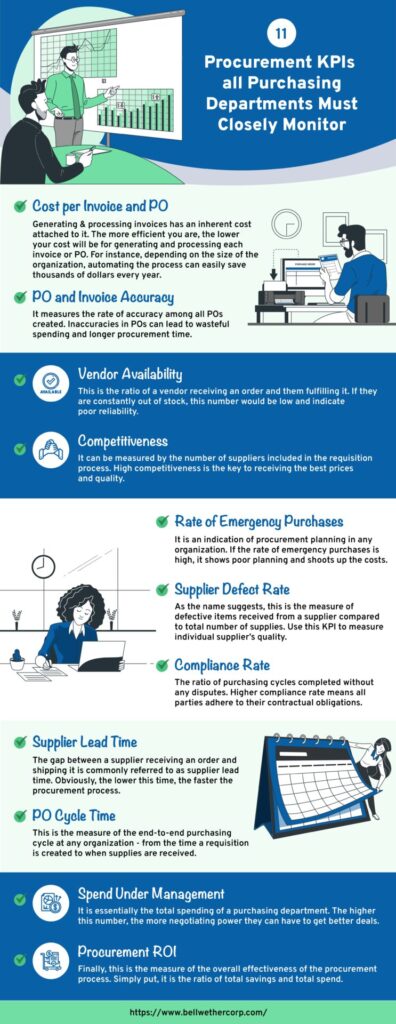
Responsible for roughly 40% of a company’s external spending, purchasing departments carry a lot of responsibilities and by extension, risks. Further, since much of their performance & productivity relies heavily on external factors like supply chain constraints, vendor availability etc., it is often tough to zero-in on the KPIs that most accurately & reliably reflect their functioning & performance.

That said, top procurement leaders have overtime, devised some KPIs to gauge into the various aspects of purchasing to get a better grasp of their their purchasing department’s functioning & efficiency. Here are the 11 key procurement KPIs along with their relevance that you too should constantly monitor:

1: Cost per invoice and PO

Generating & processing invoices has an inherent cost attached to it. The more efficient you are, the lower your cost will be for generating and processing each invoice or purchase order (PO). For instance, depending on the size of the organization, automating the process can easily save thousands of dollars every year. 

2: PO and invoice accuracy

It measures the rate of accuracy among all POs created. Inaccuracies in POs can lead to wasteful spending and longer procurement time. 

3: Rate of emergency purchases

It is an indication of procurement planning in any organization. If the rate of emergency purchases is high, it shows poor planning and shoots up the costs. 

4: Supplier lead time

The gap between a supplier receiving an order and shipping it is commonly referred to as supplier lead time. Obviously, the lower this time, the faster the procurement process. 

5: Vendor availability

This is the ratio of a vendor receiving an order and them fulfilling it. If they are constantly out of stock, this number would be low and indicate poor reliability. 

6: Supplier defect rate

As the name suggests, this is the measure of defective items received from a supplier compared to total number of supplies. Use this KPI to measure individual supplier’s quality. 

Procurement KPIs Infographic

7: PO cycle time

This is the measure of the end-to-end purchasing cycle at any organization – from the time a requisition is created to when supplies are received. 

8: Compliance rate

The ratio of purchasing cycles completed without any disputes. Higher compliance rate means all parties adhere to their contractual obligations. 

9: Competitiveness

It can be measured by the number of suppliers included in the requisition process. High competitiveness is the key to receiving the best prices and quality. 

10: Spend under management

It is essentially the total spending of a purchasing department. The higher this number, the more negotiating power they can have to get better deals. 

11: Procurement ROI 

Finally, this is the measure of the overall effectiveness of the procurement process. Simply put, it is the ratio of total savings and total spend.

source https://www.bellwethercorp.com/11-procurement-kpis-all-purchasing-departments-must-closely-monitor-infographgic/