Punchout Catalog: What it is and Why Do You Need a Punchout System?

The importance of eProcurement is widely known, yet most companies struggle to efficiently implement it due to several bottlenecks on various levels. Lately, after knowing the benefits of implementing digital procurement process, companies have started to deploy a digital purchasing software. But imagine if there are additional steps in the purchasing process that are not covered within the software? Wouldn’t that be a deal-breaker? 

Having a punchout system embedded within the software makes it easier for companies and their procurement team. A punchout system is not only a time saver but also a great way to keep track of suppliers and pre-approved goods for easy and hassle-free reordering of goods or services from within the system. 

But what is a punchout catalog? Let’s have a look.

What is Punchout Catalog?

A punchout catalog has the ability to combine e-commerce with procurement to create a singular buying system that organizations can use to streamline the purchasing process. 

A punchout catalog is also called a punchout supplier catalog. This is because it can easily integrate supplier catalogs with a buyer’s own digital procurement application or an existing ERP (Enterprise Resource Planning) solution. 

This helps the buyer access data directly from the supplier’s product catalogs which save up time. This way, the buyer only orders from trusted suppliers and the process is hassle-free. 

A punchout website, in simple terms, is a standard e-commerce website that can communicate directly with a procurement system. 

Let’s take an example – Your company’s procurement team has requested or requisitioned goods or services with the best pricing and terms & conditions available. This obviously, must have taken a lot of effort. The amount of time invested in researching suppliers and finally cracking the best prices is nothing compared to the result of actually ordering goods or services from the perfect supplier. 

But this research would be a waste if the buyer has to go through the same process manually when ordering goods or services the next time, right? This is where the punchout catalog comes into the picture. 

If the supplier’s details are saved after ordering goods or services the first time in a catalog, it would save the buyer and the company a lot more time. This way, the procurement team can directly connect to the entire supplier catalog and browse pre-approved goods or services at the best pricing and terms available. All this without leaving your existing eProcurement software. 

Exciting, isn’t it? The job of a punchout catalog is essentially, to present a supplier’s offered goods or services in the catalog for easy ordering. When this punchout catalog is integrated with your existing eProcurement system, you can place orders without even leaving your digital procurement software. 

Most importantly, the punchout catalog when integrated within an eProcurement system is a blessing for buyers and a dream come true for any organization. 

How does punchout work?

The punchout process involves the following steps:

  1. First, the procurement manager or the buyer opens the company’s existing eProcurement or digital procurement system. 
  2. Once the buyer locates the supplier and selects it, the eProcurement system redirects the buyer to the supplier’s e-commerce store or B2B marketplace. 
  3. The system can automatically authenticate the buyer and logs them into the supplier’s online store. 
  4. Now, the buyer can look at the products available in the supplier’s catalog as they are browsing the supplier’s site. Here, the supplier can also provide the buyer with custom products or services at discounted prices, negotiated previously. The buyer can add the products to the cart just like one would in an actual e-commerce store. 
  5. Once the buyer has added all the products in the cart, instead of checking out, they will punch out. This essentially means that the system automatically exports the order data to the buyer’s eProcurement system for approval. 
  6. The purchase order (PO) will then need to be approved in the buyer’s eProcurement platform. Once approved, the system will create a PO in the supplier’s e-commerce store, and further, the usual delivery process will be initiated for product delivery. 

The punchout process is rather simple. Additionally, it enables the procurement manager or the buyer to order products from the same system while staying within an internal eProcurement system that keeps a track of all transactions. 

Why do you need a Punchout system?

A punchout catalog aids in reducing purchasing errors within an organization. The reduced errors mean faster purchasing, improved speed and accuracy. This means there isn’t much work that needs to be done before you get a product or a service from a verified vendor. 

Let’s have a look at the benefits of a seamless and integrated punchout system and why you need it.

  1. Increased ordering and hassle-free checkout experience

When your existing eProcurement software has a punchout system integrated within it, buyers have access to thousands of products or services, with pre-approved suppliers which makes it easy to place a quick order. 

  1. Shopping as convenient as B2C

Many B2B companies dream of the checkout convenience which is experienced by the B2C companies. With a punchout system, the buyer’s experience is more simplified. The re-ordering will be faster and more convenient just like a B2C experience. The buyers can also buy products and conduct searches within a familiar User Interface (UI). 

  1. No maintenance for external links 

Since the systems access third-party products and are handled by their own publications, your organization will not accrue any expense to maintain the third-party website. 

  1. Centralization

The suppliers that are preferred by the procurement team of a company are all concentrated in one application. This promotes better consolidation and increased efficiencies. 

  1. Access to negotiated prices

When a particular supplier is added to the catalog, it is possible that the bulk prices which were earlier negotiated with them are in the catalog now. Procurement managers have access to these negotiated prices of preferred vendors right here on this catalog.

  1. Faster processing speed

With an integrated punchout system, buyers can speed processing, order fulfillment, and special and urgent requests. The entire purchasing process is automated making the punchout system more optimized and accelerated. 

  1. Efficient enforcement of buying policies 

Using the punchout catalog gives buyers the ability to reorder faster and get speedy approvals on all orders and integrate catalogs with the desired suppliers. Buyers can enforce their buying policies based on punchout reorders.  

  1. Access to previous orders and negotiated prices

Authorized users and procurement managers gain access to the previous orders that have been ordered using the punchout system. The negotiated bulk prices from preferred vendors are right on the catalog pages, making it easier to reorder from verified and trusted suppliers. 

  1. Fully integrated catalogs

Different types of catalogs can be integrated into an organization’s existing digital procurement software including punchout catalogs, hosted catalogs, and internal catalogs. Additionally, authorization protocols can be uniquely set to meet contract-compliance requirements as well. 

  1. Status reports are automated

Order statuses are alerted to the buyers early in the buying process when a fulfillment issue arises. This reduces disputes, returns, and delays and helps an organization save up on valuable time. 

  1. Competitive advantage

Companies that have a punchout system integrated with their existing eProcurement solution have seamless purchasing benefits. This helps organizations gain control of the entire purchase-to-pay (P2P) process and deliver B2B automation to their valued customers. This helps in the growth of sales and drives higher customer satisfaction rates. 

Conclusion

Finally, we understood that a supplier punchout catalog is a supplier’s e-commerce website that is accessible to the buyer from the company’s existing eProcurement solution. This allows the buyer to browse and search for the supplier’s products from within the internal eProcurement system and then order and purchase the selected supplies online. 

With Bellwether’s digital procurement solution, you can easily integrate into the punchout catalog and access your supplier’s offerings – all in one place. From requisitioning to ordering goods or services from your supplier – you don’t have to look anywhere else. Bellwether can do it all! 

Get a Demo now to check it out.

source https://www.bellwethercorp.com/punchout-catalog-what-it-is-and-why-do-you-need-a-punchout-system/
8 Features Your Purchasing Software Must Have

In recent times, implementing a digital procurement solution is widely considered by many organizations and for a good reason. The changing times call for immediate and effective measures in the supply chain and procurement industry. The global pandemic highlighted the flaws in the supply chain and established a strong need for the industry to go digital. 

Organizations are looking to make their supply chains resilient so that they can withstand most contingencies and not fall in times of a crisis. The best way to keep track of all your purchasing requirements and supply chain activities is through digital purchasing software. 

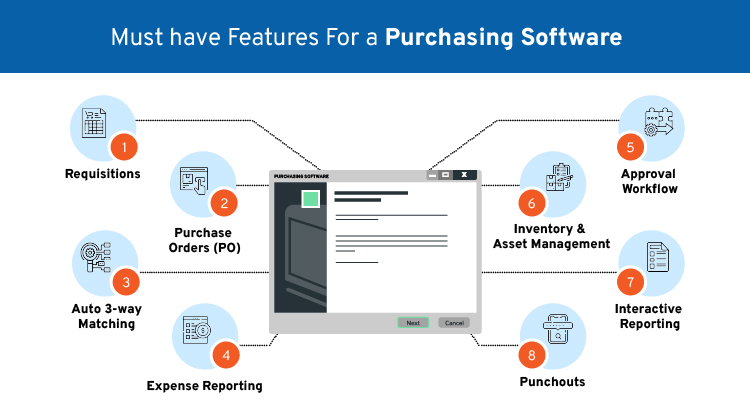
Choosing the best purchasing software for your company can be a daunting task. However, if you look for the must-have features in your digital purchasing software, you are on the right track. But, what exactly are these features? Let’s have a look at some of the must-have features in a purchasing software.

Requisitions

A purchase requisition is essentially an internal document used by employees to inform department managers in an organization about the resources they need. This document is used to request a purchase of goods or services. The employees request this purchase on behalf of their organization. This document is not legally binding as such. 

The purchasing process begins once the purchasing manager receives this document and they initiate the process. A requisition can be viewed by anyone who is in charge of purchasing at your organization. The details required before completing a purchase are highlighted in a purchase requisition i.e. if it is approved. The details include product description and quantity, name of the vendor, price of the goods or services, and name and department of the purchaser or the buyer. 

Why is this a must-have feature in purchasing software?

The purchase requisition plays a key role in the buying process of any organization. This is because the purchasing process is initiated by a requisition itself. Since everything is digitally recorded in the digital purchasing software, this ensures the prevention of fraud and organizations get their value for money. 

Additionally, a requisition should go through an approval process after which a purchase order is created. This makes it easier to trace goods, making it extremely easy for the purchasing and accounting departments to handle the purchasing process and keep track of the spend. 

The benefits of a purchase requisition include the following:

  1. They are helpful for financial audits i.e. increased transparency
  2. Your organization can avoid duplicate orders
  3. It helps in better organizing your orders
  4. They prevent miscommunication 
  5. A requisition helps in assessing the legitimacy of the need 

With the help of a purchase requisition, you can seamlessly track your orders and get the procurement process started. This will not only increase transparency in your purchasing cycle but also help in establishing a better audit trail.

These terms and conditions are extremely important in a new business relationship as trust has not been established yet. They protect your organization’s interests and ensure legal protection in the event of under-fulfillment of orders. 

Purchase Orders (PO)

Purchase orders ensure that there is a smooth transaction between a buyer and the seller. In simple terms, purchase orders (POs) are documents sent from the buyer to a seller i.e. the supplier with a request for an order. The PO highlights the specifications of a requisition including order description, the number of items or details about the service to be provided, and the agreed-upon payment terms and conditions.  

When the supplier or vendor accepts the PO, it becomes a legally binding contract between the two parties. While many organizations think of POs as an added extra step in the purchasing process, they help to ensure a smooth transaction between the buyer and the seller. 

Most importantly, creating a purchase order means the risk of fulfilling an incomplete or incorrect order is drastically reduced. The buyer can clearly and explicitly communicate their request to the seller. Since the PO is a legally binding contract between the buyer and the seller, if the buyer refuses payment after the delivery of goods, the seller is protected. 

Why is this a must-have feature in purchasing software?

Paper-based POs will only pull your organization down. If your organization is still using manual POs, you have opened yourself to a range of potential errors which can be otherwise avoided with digital POs. Electronic POs are the way to go.

A good digital purchasing software can provide greater transparency into every stage of the purchasing process. This is mainly possible because of the purchase order and the approval steps every order goes through. 

The benefits of a purchase order include the following: 

  1. Easier to track orders i.e. increased transparency
  2. A digital purchasing software will allow order approvals to be faster
  3. A PO will avoid unnecessary expenditure and fraud
  4. Efficient record-keeping which leads to reduced maverick spending
  5. Going paperless also means increased sustainability 
  6. A PO helps with budgeting and saves time
  7. Provides legal protection to both the buyer and the seller
  8. Helps to plan ahead
  9. Improves inventory management 
  10. Helps to control and track spending 

Purchase orders give detailed insights into your company’s spending. They help the accounting team to reconcile spending. Buyers make purchases effortlessly and this streamlines the entire purchasing process. 

POs give you a deeper insight into which vendors are easy to work with, how much inventory you have, where your money is going and finally, help in establishing a solid audit trail.

Auto 3-way Matching

Just like any other feature in the procurement process, 3-way matching works best if it is automated. The perils of manual invoice matching have become evident with the pandemic and this has highlighted the increasing need for automation. 

By automating the 3-way matching process you can improve relationships with your suppliers, reduce human error, lower processing costs, and improve control and visibility in the purchasing process. 

Simply put, a 3-way matching is a process of matching purchase orders (PO), goods receipt (GR) note, and the vendor’s invoice. When you match all these 3 documents you eliminate any risks involved with fraud, save money, and maintain enough records for the audit trail. 

Why is this a must-have feature in purchasing software?

3-way matching focuses on verifying invoices by looking at relevant documents which prove that the goods or services were requested and an invoice was issued for the same, and the goods or services have been received for which the invoice was issued. This can easily determine whether the invoice is legitimate or fraudulent. 

In short, 3-way matching ensures related documents are cross-verified to authenticate an invoice before paying out. 

Here are the benefits of having the 3-way match feature in your digital purchasing software: 

  1. Tracks the origins of an invoice
  2. Confirms the legitimacy of the invoice to avoid fraud
  3. Helps to track payments to a particular supplier which ensures transparency
  4. Protects businesses from unnecessary expenses which, in the long run, increases the bottom line profits
  5. Helps to establish a full-proof audit trail

The main aim of auto 3-way match is to eliminate fraud and to ensure all incoming invoices are correct before going ahead with the payment. An automated 3-way matching in purchasing software can help you to store POs once created, collect receiving reports, and automatically match POs and receiving reports alongside invoices once received. 

Purchasing software Features

Expense Reporting

Expense reporting is not given as much importance as it should get. It is not considered as important as managing your purchase order process or tracking vendor performance. However, expense management and reporting is equally important when it comes to managing your organization’s finances and the method you use to report expenses. 

When you have expense reporting as a feature in your digital purchasing software, it makes it easier to stay on top of tax responsibilities, build better budgets, and get an idea of what you can deduct when the tax season is near. Not only this, they also help you get ahead of employee fraud and misused company cards. 

Why is this a must-have feature in purchasing software?

An expense report can vary by company but generally, they include fields like employee/contractor name, transaction date, category of the expense, amount, total reimbursement amount, etc. 

The expenses which fall under an expense report must have a business connection and they must be promptly submitted. Further, overpayment of expenses must be returned in a timely fashion. Expense reports can also help the company track the budgets spent for a particular quarter and what is remaining for the next quarters. 

When your company opts for a feature like this, they can stay on top of their business expenses, budget better for the future, track employee travel expenses, keep a track of the cost of goods sold, and much more. This will positively impact your company’s bottom line profits and this increased transparency will help in saving money and avoiding fraud.  

The benefits of expense reporting include the following:

  1. Legal compliance for tax deductions
  2. Effective spend management and forecasting
  3. Audit trails in the event of a fraud
  4. Helps to establish budget trails
  5. Promotes compliance within the company

The accuracy of expense reports relies mostly on the abilities of employees to submit their expenses and receipts on time and spreadsheets and excel sheets are prone to human errors and delays. Expense reports can be immensely beneficial to a company and what will make them convenient if they are a part of an automated purchasing software. 

Approval Workflow

Approval workflows or purchase approval workflows are a formal way to approve certain spend requests made by team members. With a personalized approval workflow in place, organizations can track every single penny spend and cut unnecessary costs. This contributes to a successful bottom line. 

Approval workflows can be a great way to track your spending and determine if you are going over the budget or running out of cash. The entire spend management process can be streamlined with a well-designed purchase approval workflow as they help team members save time. 

Incessant emailing to get approval on a purchase is inefficient and labor-intensive. With the right digital purchasing software, everyone can understand who is requesting money, who is assigned to approve it, and where in the process the request is. 

Why is this a must-have feature in purchasing software?

Having an efficient purchase approval workflow process is one of the most effective ways to keep a track of spend and control it. Moreover, it helps to keep fraud in check and improves the cash flow position of your company. 

Designing an automated purchase approval workflow helps members of your organization understand how to purchase goods and services. Because of approval workflows, people feel accountable for what they are ordering and why. 

Here are the benefits of having a purchase approval workflow in place:

  1. It increases the operational efficiency of the organization 
  2. There is a check on rogue spending and hence, the cash flows are controlled
  3. Full visibility into budgets and budget compliance
  4. Audit compliance
  5. Increased negotiating power with vendors as we have a full picture of advanced orders 

Automating the approval workflow process is the way to go forward to building the most effective streamlined process. Organizations can customize approval workflows based on a number of users, departments, locations, etc. depending on specific requirements.

Punchouts

A punchout catalog has the ability to combine e-commerce with procurement to create a singular buying system that organizations can use to streamline the purchasing process. 

A punchout catalog is also called a punchout supplier catalog. This is because it can easily integrate supplier catalogs with a buyer’s own digital procurement application or an existing ERP (Enterprise Resource Planning) solution. 

This helps the buyer access data directly from the supplier’s product catalogs which saves up time. This way, the buyer only orders from trusted suppliers and the process is hassle-free. 

Bellwether Punchout Catalog

Why is this a must-have feature in purchasing software?

With an integrated punchout system, buyers can speed up the processing, fulfill orders on time, and take up special and urgent requests. The entire purchasing process is automated making the punchout system more optimized and accelerated. 

Companies that have a punchout system integrated with their existing purchasing software have seamless purchasing benefits. This helps organizations gain control of the entire purchase-to-pay (P2P) process and deliver B2B automation to their valued customers. This helps in the growth of sales and drives higher customer satisfaction rates. 

Here are the benefits of having punchouts as a feature in your digital purchasing software:

  1. A centralized platform where you can select from the best suppliers to order from
  2. Hassle-free checkout experience 
  3. The convenient shopping experience, just like B2C
  4. No maintenance for external links
  5. Access to already negotiated prices

Interactive Reporting

Just like the name suggests, interactive reports are where you as end users can create highly customized reports. You can even alter the way a report looks by hiding or exposing certain columns, applying filters, highlighting, and even sorting. 

Essentially, when you use interactive reporting, because of customization at your disposal, it serves as multiple reports rolled into one. A single interactive report can give you a view of your data from any angle you desire. You can even control which data to include and which data to let go of. There are tasks which previously required multiple reports, that now can be clubbed into one. 

Here’s why this is a must-have feature in purchasing software:

  1. Interactive reports have adjustable row dimensions and the user can choose which row should appear in what order
  2. It can easily adjust to mobile devices 
  3. They allow the user to save their searches and this saves valuable time 

Inventory & Asset Management

Inventory management is one of the most important features to be considered while choosing a purchasing software. Managing inventory means you can identify which stock you have and how much of it you have when to order more and at what time. Inventory management helps the company to maintain a healthy inventory turnover ratio. 

On the other hand, asset management takes care of overseeing items a company uses to operate. Managing assets means you need to track equipment, vehicles, devices, computers, furniture and fixtures, etc. Asset management traces the complete lifecycle of an asset i.e. from when the company buys the asset to its disposal. 

How do asset management and inventory management work together?

  1. Inventory management and asset management both track and record stocks
  2. They help to manage and keep the supply chain in check
  3. They reduce operating costs
  4. They leverage real-time data
  5. They use barcodes and RFID to prevent losses
  6. Finally, when they work in tandem, they help in maximizing return on investments (ROI)

A purchasing software which has an inventory and asset management feature is the cherry on the cake as such software can meet current needs and adapt to future ones. An automated purchasing software comes with real-time tracking of inventory and assets which will keep your organization ahead in the game. 

Conclusion

Making the transition to a digital purchasing software can be challenging sometimes. But when you are aware of the features you need to look for in a software, it makes the decision simpler. 

When you implement a digital purchasing software, it not only streamlines the purchasing process but also speeds up the entire P2P process. A digital software reduces the risk of supply shortages and strengthens your relationships with suppliers. Your organization can avoid maverick spending and save costs while keeping a check on overspending. 

Get yours now! Get a Demo.

source https://www.bellwethercorp.com/8-features-your-purchasing-software-must-have/

How to Build an Effective Spend Management Policy for your Company

The long-term success of your business depends on a variety of factors that contribute to the financial health and competitive strength of your company. Managing the financial health of an organization is crucial to achieving profitability. Managing the money flowing in from sales, investors, and funding is essential but it is equally important how you choose to drive value. 

Earlier, the goal of spend management would be to slash costs wherever possible as every business unit or department worked towards achieving this simple goal. However, the flourishing impact of digital transformation has changed the way businesses look at spend management’s use in procurement. 

Spend management in procurement has gained importance in recent times. More businesses are looking to change the direction of procurement from simple cost savings. Proactive value generation, risk reduction, and strategic support are the focus now.

What is Spend Management?

Management of spend is essentially providing valuable insights via centralized, transparent data management and real-time data analysis. It also includes managing costs and savings and reduction of risks through process optimization, systems integration, and continuous improvement. 

An efficient spend management process includes mitigation of risks through internal controls, supply chain optimization, and process automation. It is also crucial to have robust supplier relationship management to consistently provide essential materials and services.

Additionally, intelligent contract negotiations and management through effective cost savings, integration with finance and other departments, financial reporting and budgeting, and strategic planning are all part of the spend management process. 

Lastly, an important aspect of the spend management and expense management process includes attention to intangible value sources like environmental and social responsibility as well as reputational risks. 

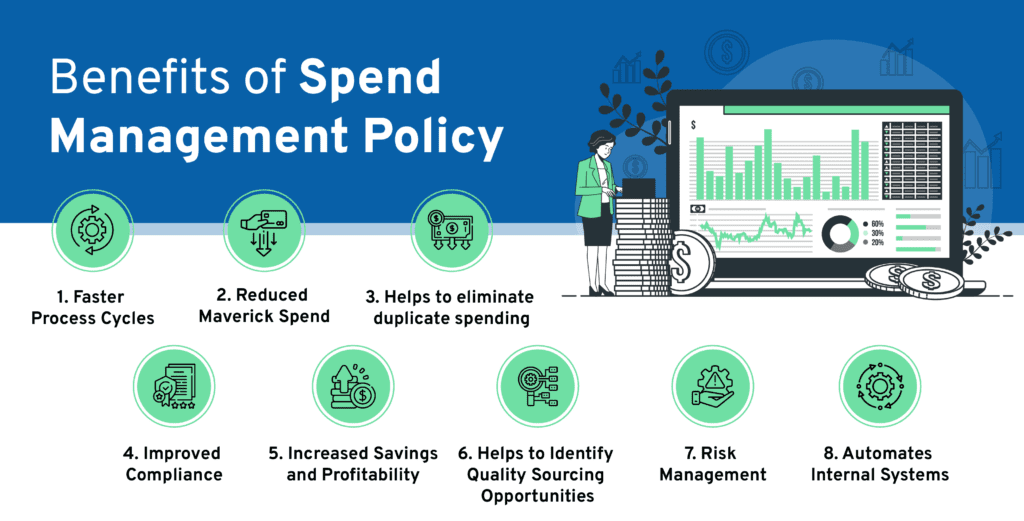
Benefits of spend management policy

Implementing a spend management policy will not only help boost bottom-line profits but it will also help in effective management of expenses. Here are a few more benefits of implementing a spend management policy.

Benefits of Spend Management Policy

1: Faster process cycles 

In most companies, the process cycle times vary depending on the line of business. With a spend management policy in place, optimal decisions like designated suppliers, contract terms negotiation, etc. are pre-defined, which further help in reducing the process cycle time. Recurring activities like selecting a supplier and contract authorization are regularized by spend management policies. 

2: Reduced maverick spend

When you analyze your company’s spend using spend reports, you can correctly identify maverick spending and avoid it successfully. This leaves less room for error because of the transparency provided by spend management. The ability to collect data in organized formats helps outline any anomalies and stall unauthorized spending.

3: Helps to eliminate duplicate spending

A solid expense management strategy makes it easy to reveal duplicate payments in a single invoice. In simple terms, spend management helps keep payments in check.

4: Improved compliance 

Implementing a spend management policy means improved spend visibility. Such a policy helps with audit trails i.e. it becomes easier to trace, collate, and document expenditures that improve visibility into spend. This helps to comply with major regulatory requirements.

5: Increased savings and profitability

The most important and primary objective of a spend management policy is to identify and exploit savings opportunities. These eventually improve a company’s productivity.

6: Helps to identify quality sourcing opportunities

Management of spend means all expenses can be managed in one place and can be seen under reports. When such spend data is collated, it helps in showcasing expenditure on products inclusive of all peripheral costs, thereby securing cheaper and better quality sourcing opportunities.

7: Risk management

Analysis of spend helps an organization manage and monitor transactions to keep a track of the financial performance of vendors and their credibility. In the procurement industry, most projects are heavily dependent on suppliers, and knowing their credibility beforehand enables procurement managers to choose wisely.

8: Automates internal systems

Because of a spend management policy, an organization can look to automate its internal procurement processes as well. This will help a company to bring about visibility in the spending environment.

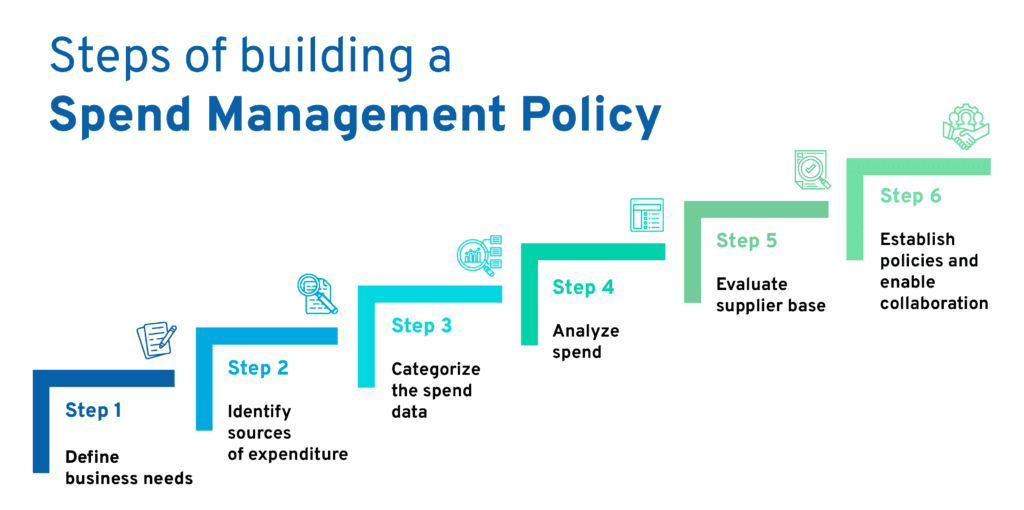
Steps of building a spend management policy

Here are 6 steps to consider while building a spend management policy:

Spend Management Policy Steps

Step 1: Define business needs

Defining business needs and establishing where your company stands currently, what is required to achieve business objectives, etc. is crucial. This can include knowing if your processes are manual or automated, do you have a decentralized procurement process or centralized, if your team is growing, etc.

Step 2: Identify sources of expenditure

Once the above step is done, it is essential that your company determines the sources of expenditure which can include employee salaries, licenses, utilities, rent, etc. These sources of expenditure are unique to every organization depending on the nature of the business. Hence, this is an activity every business must carry out uniquely.

Step 3: Categorize the spend data

Spend can be classified into various types of spend in a company. These classifications and categories are created depending on the objectives and operations of an organization.

Step 4: Analyze spend

Once you have collected and categorized spend data, analyzing it will highlight which expenses are recurring and if there are any anomalies. When your company starts analyzing spend, they can determine cost-effective strategies which can help drive growth in your organization.

Step 5: Evaluate supplier base

A healthy supplier base is a key to a successful spend management strategy. With spend analytics, your company can conduct periodic supplier audits and streamline and simplify them with the help of analytics and reporting capabilities of a spend management policy.

Step 6: Establish policies and enable collaboration

While building an effective spend management strategy, it is essential for the various departments in your organization to work in cohesion with the teams. Establishing procurement and spend management policies will ensure compliance. Your spend management policy will be successfully set up.

Challenges in spend management

1: Lack of accuracy in data

Spend data when entered manually is plagued with inconsistencies and errors. Complex data types which involve multiple aspects – if handled manually – are a riot on paper. This can lead to misguided decision-making and can also lead to increased costs.

2. Lack of awareness of spending sources

The primary step to spend management is to identify all sources of expenditure within an organization. It is essential that a business identifies cost centers and involves all the department heads responsible for costs. With manual processes, this becomes difficult for businesses and that is where managing spend becomes a challenge.

3. Bad analytics capabilities

Analytical skills are rare and expensive and not everyone can afford them. Hence, it becomes a challenge to extract the right kind of data from reports and analyze it. Investment in analytical capabilities is difficult as there are no immediate results which are visible.

4. Insufficient resources

Procurement teams have their hands full with their daily tasks of buying, managing supplier relationships, processing purchase orders, etc. Spend management requires a special skillset to analyze reports and come to conclusions which could help a company grow.

5. Multiple authorities

It is common knowledge that multiple department heads have to work together to collate data for managing spend in an organization. Collecting this data is not easy as it means encountering varying interests, lack of cooperation from people of different departments, and much more.

6. Resistance to change

Very often, spend management is looked at as a threat to some stakeholders in an organization. This means that not every department involved would be happy with the degree of transparency that comes with expense management.

While the above challenges seem difficult to overcome, that is not the case. With the right spend management solution and an automated procurement software which supports spend management, it is possible to make managing spend effective and resourceful. 

Challenges come with solutions and can be overcome with the right spend management strategies. This will help an organization with maintaining transparency and locating errors more easily. The profitability of a company grows exponentially when spending is managed efficiently. 

Conclusion

The importance of spend management starts growing exponentially when the expenditures of an organization increase. In simple terms, the growth of expenses is directly proportional to the importance of spend management in a company. Optimizing the spending process and keeping a track of expenses is essential. 

Bellwether’s digital procurement software can automate your purchase to pay (P2P) process and help with managing spend of your organization and gaining transparency in the processes.

source https://www.bellwethercorp.com/how-to-build-an-effective-spend-management-policy-for-your-company/

Purchase Approval Workflow Guide

The pandemic has put light on various gaps in the supply chain and procurement industry which has made companies more aware and focus on resiliency. The objective of every organization is to fill the gaps in their supply chains. Effectively managing spend is one step closer to their goal. 

Having an efficient purchase approval process in place can help your organization in managing spend effectively. One of the major reasons behind a company’s downfall is the inability to manage cash flow. While making money, an organization should also be able to keep a track of where the money is spent. 

Expenditure control is crucial to any organization and purchase approval workflows are the way to go. An efficient purchase approval process can go a long way in helping a company achieve its bottom-line goals and effectively manage cashflows. 

What is a Purchase Approval Workflow?

We know that purchase orders (PO) are crucial for a company as they help in streamlining the purchasing process and managing spend. An efficient PO system ensures a timely purchase order approval process and timely payments. 

Simply put, a purchase approval workflow is a formalized way to approve certain spend requests made by the members of a team in an organization. 

A purchase approval workflow comes in handy especially when your organization deals with the everyday purchasing of new equipment, raw materials, etc. These workflows will set clear checks and balances for spend requests made by buyers. 

In the absence of a spend management system, a buyer has to incessantly email the purchase manager to approve a purchase. This is highly inefficient, time-consuming, and labor-intensive. With the correct purchase order approval system, there will be transparency in understanding who is requesting money, who will approve it, and which item is being requested for what process. 

When there is an approval workflow in place, there is transparency over everything that a company orders and processes. This helps to cut down on maverick spending in an organization and every purchase is accounted for. 

A well-designed purchase order approval workflow keeps over-spending at bay and as a result, your organization will never run out of cash. A good purchase approval system can streamline your entire spend management process which will save your team members’ time. 

One of the easiest ways to cut costs and generate revenue is by automating your purchase order approval process. 

How does a purchase approval workflow work?

The purchase order (PO) becomes a legally binding contract when different stakeholders validate the PO. It passes through various internal processes of the buyer and vendor before becoming a legally binding contract between the parties. 

Once a request is raised, it is sent for approval to purchase managers. Requests can also get rejected if they do not meet certain pre-determined criteria. Once approved, an order is created by the purchase manager and then that passes through an approval process. In simple terms, this is the purchase approval workflow process. But let’s have a look at it in detail. 

An approval workflow follows a set sequence which is as follows: 

Step 1: Creating and completing a request to spend 

The purchase approval process always starts with a request for spending i.e. by a requisition, purchase order, etc. This states the intention to spend. 

When an individual or a department is in need of goods or services, they submit a detailed requisition. This request/requisition contains details about the item/service, price, etc. This gets submitted either to their supervisor or manager or directly to the procurement department. 

If the approving party is the supervisor or manager, the request may require multiple approvals depending on the price or quantity requested. Once this purchase requisition is approved, it is passed on to the purchasing department. 

Step 2: Following the chain of approval

The approval chain is also known as approval routing wherein all stakeholders are required to approve a purchase before it happens. 

The purchase department reviews the request for accuracy of the information, policy compliance, legal requirements and procedures, etc. In this step, the department also makes sure that the requesting party has the budget to support the purchase. 

Based on the verification of the above details, the purchasing department either accepts or rejects the request. If the request is rejected for misinformation or incorrect item details – anything which is not a monetary reason – then it may be returned to the requestor for resubmission. 

A well-documented approval chain not only creates transparency in your spend but also streamlines accounting for the entire accounts payable team who investigated unusual transactions or fraud. 

Step 3: Understanding permission levels

When assigning purchase approvers for approvals, many factors need to be taken into consideration. Typically, day-to-day purchases required for daily operations usually require only one approver. This is usually the department manager. 

However, when it comes to larger purchases, purchase approval chains require more than one spend approver – typically 3 or 4 stakeholders – many of whom undertake all spending in an organization. Permission levels mostly account for absent approvers as well i.e. if an approver is on vacation, there is usually a proxy approver in place. 

Step 4: It is important to set clear timeframes 

An approval workflow process is all about setting clear time frames. A clear timeline helps streamline the purchasing process and creates a good relationship with vendors. 

A purchase approval workflow process is only valuable if it removes the procurement difficulties of your team aside and frees up their time to do more important stuff in a day. 

Step 5: Audit logs 

Audits are dreaded by many of us but, we can choose to be terrified by them or we can choose to be prepared for them. A secure audit trail is a secret to success for any organization. 

Whether it is a spend management software or spreadsheets, your company needs to ensure that there is a handy way to securely access the audit trail and track the approval process for every single spend request. 

When every single aspect of your purchase approval process is documented, it can be made into a formal spend policy template. This template can be used by your organization and should be made a part of the company’s culture. 

How to create a purchase approval system for your organization?

If your organization has been or still is following the traditional procurement ways, you already know that it is time-consuming, labor-intensive, and heavy on wasted resources. Even if you are using spreadsheets to keep a track of your spend, the entire process is still rife with potential problems and risks if you are not automating the purchasing process. 

Using an automated purchase order software, companies can start customizing approval workflows by dollar thresholds, departments, users, etc. depending on specific requirements. A custom workflow will also depend on the size of your business and the spend culture of your organization. 

While setting up a purchase approval workflow process for your organization, an organization can consider the following points: 

  1. Take a long moment to look at your organization’s purchase categories. The reason is – that not all purchase categories follow the same process. Looking at past purchases can help you get a better idea of what your company is purchasing and which orders are currently going through the purchase order approval process. 
  2. Figure out which purchases need to be passed through multiple layers of approvals and which purchases need a simple approval process. If simple day-to-day items have multiple approvers, it will make the purchase approval workflow process slow, rendering it inefficient. 
  3. Set a minimum dollar threshold for approval. In this way, only items above a certain dollar limit will go for multiple approvals. 
  4. Have a look at which items need a single-level approval and which items need a multi-level approval. 
  5. Make sure you maintain budgets that will provide visibility into budgets for approvers. 
  6. It is essential that an organization figures out how to facilitate requests for spend from all the team members. 

Upgrading to automation enabled purchase order software invites a plethora of benefits and some of them include the following:

  1. Increased productivity and efficiency throughout the organization
  2. Fewer errors and higher accuracy 
  3. Reduced maverick spending 
  4. Elimination of unnecessary spend, and much more. 

Conclusion

No matter how often you have faced the problem of maverick spending and inefficiency in your purchasing process, having an automated purchase approval workflow system in place will help your organization greatly. 

With Bellwether’s completely automated purchase-to-pay (P2P) software, you can easily setup a purchase approval workflow process and get started on your journey of procurement savings.

source https://www.bellwethercorp.com/purchase-approval-workflow-guide/

The Complete Handbook for Purchasing Managers to Succeed in 2022

Cost savings for an organization come in ways that are unexpected for many. Scores of companies have taken procurement for granted over the years and have not bothered to spend time or money on the seamless functioning and management of the (Purchase-to-Pay) P2P process. 

The procurement process is complicated and the manual hassles involved are highly prone to error. This happens because of an inefficient procurement management process that heavily relies on manual processes. 

Manual P2P processes are riddled with maverick spending, lost documents, and a slow approval process among many other issues. As a result, the supplier relationships take a massive hit which leads to poor vendor management, late payments, etc. Somehow, plenty of companies still run such complex processes. This essentially means that a chaotic procurement process is a way of life for many organizations. 

However, it is never too late to get rid of the traditional and manual procurement management methods. Automating your procurement process is the way to go for an efficient and seamless P2P process. 

What is Procurement Management?

Procurement is a complex function that involves multiple labor-intensive and time-consuming processes. The efficient management of procurement activities can help get rid of these tedious processes. 

In simple terms, procurement management includes the management and optimization of organizational spend with a strategic approach. 

There are multiple functions involved in the procurement management process namely, sourcing, requisitioning, ordering, receiving, inspecting and matching, and reconciliation. It also includes procuring quality goods and services from selected vendors within a stipulated budget, on or before the deadline. 

So how exactly will procurement management benefit your organization to achieve success? Let’s take a look at the importance of procurement management. 

Importance of Procurement Management

Managing the procurement activities not only keeps business operations running smoothly but also saves money, time, and resources. The main aim of procurement management is to avoid costly delays and errors. 

An organization’s most time-consuming and tedious process is the procurement process when it is manual. When managed digitally, procurement can work wonders for your organization. However, many companies still resort to complex and manual procurement processes. This could be because many of them think of e-procurement as an unwanted and avoidable cost for their company. 

This is, most definitely, not true. Automating your organization’s procurement process can offer a wide range of benefits. These benefits include:

  • Increased spend visibility
  • Enhanced efficiencies
  • Improved spend management
  • Better management of supplier relationships
  • Reduced processing cost and time
  • Better cost efficiencies
  • Enhanced productivity
  • Improved compliance
  • Risk management 
  • Controlled maverick spending, and much more. 

Hence, making the transition from traditional to digital procurement and automating your purchase-to-pay (P2P) cycle will be one of the best decisions you can make for the longevity of your business. 

Now that we have understood the benefits of automating your company’s P2P cycle, let’s understand how to make procurement management successful. 

5 Key Steps for Successful Procurement Management

  1. Planning and specification

To start with, procurement teams must put together a cohesive procurement plan specifying the goods and services needed. A detailed list of this will help in establishing a budget and staying organized from the start. Being organized will help the team to be prepared for contingencies and any further steps will go ahead as smoothly as possible. 

  1. Identification and selection of suppliers

Next, choosing potential suppliers must be a priority and you should make sure that they meet the company’s exact needs and specifications. This can be done accurately with meticulous research and identification. 

  1. Requesting a proposal and negotiation

After you have narrowed down the suppliers for your organization, you will need to start requesting proposals and negotiating with them as needed. The negotiation process is crucial as this can enlighten you on the suppliers’ dependability and trustworthiness. Make sure the suppliers know your company’s requirements and that they are communicated clearly to them. 

  1. Tracking deliveries and payments

Now that you have selected a supplier and entered into a contract, it is your purchasing department’s responsibility to handle and control the deliveries and payments. To ensure a smooth procurement process, it is essential that deliveries are carefully tracked, all orders are reviewed and regular meetings are held with your vendors. 

  1. Measurement and analysis

Finally, it is crucial that you analyze the entire P2P process using an established system of key performance indicators (KPIs). These KPIs will help in analyzing the cost efficiency, efficacy, speed, and success of the procurement process. You can also identify any areas for improvement and suggest any changes to be made. This will help in making any future projects a success. 

Functions of Procurement Management

Procurement consists of numerous functions but, here are a few important and most-used functions of procurement that are the most important to automate. If your company can get rid of the manual aspect in the following functions, there will be improved productivity while saving more time and money. 

  • Purchase Requisition

A requisition is crucial to any organization’s procurement process. The requisitioning process allows staff members to create a record of their requested items from a list of approved vendors. This replaces the manual process of ordering anything, anywhere and anytime from any random vendor. 

Once the requisitioning process is automated, any misleading information can be spotted easily since there is no room for error or inaccuracy in requisitions. What keeps the requisitioning experience consistent every time is a procurement management software that offers electronic data capture and approvals. 

  • Purchase Order (PO)

A purchase order is extremely crucial to a company’s procurement process. Requisitions made are converted to purchase orders and there is no need for manual paper-based purchase orders or data entries. Depending on the number of line items and vendors, approved purchase requisition can become as many POs as necessary. 

With efficient digital procurement management software, anyone with appropriate permissions can locate a PO in the approval chain at a given point in time. This ensures maximum transparency to the stakeholders as well. 

  • Invoice Approval

Say goodbye to the days of manual invoicing where it was common for an item and price mismatch. Procurement automation can make invoice approvals and processing more efficient and accurate since this is a prominent procurement process. 

When a supplier or a vendor submits an invoice for approval, the procurement management solution reads the paper invoice and digitizes it, and checks for any available information like supplier name, contract payouts, and PO limit. If there are any discrepancies, the invoice will not be approved based on predefined rules. This ensures that the payment will not be processed unless the discrepancies are corrected. 

  • Inventory Management

Automating the procurement management process helps you to keep track and control your inventory based on holding levels. It can also minimize costs and bottlenecks and manage current and future stock requirements. 

The inventory visibility in supply chains is at its maximum if this process is automated. A good procurement management software can capture accurate data throughout the operational process ensuring stock is available when needed and the right quantities are ordered. 

  • Vendor Management

Vendor management holds an important place in the procurement process. The vendor selection process is usually a manual and time-consuming process. With the help of procurement management software, this process can be automated. 

Tasks like background checks and review, supplier RFQs, follow-ups in case of missing documents or information, etc. can be easily automated. 

  • Contract Management 

This essentially means collecting and managing contracts across the organization and securely storing them. This process sounds complicated in itself and hence, manual contract approvals take forever to be processed. 

Procurement management software can automate this process and make it more efficient to manage contracts, hence saving time. This system will review these contracts and compare them against pre-defined templates hence, making it easier to point out errors and fluctuations in terms and conditions.  

Kraljic Matrix

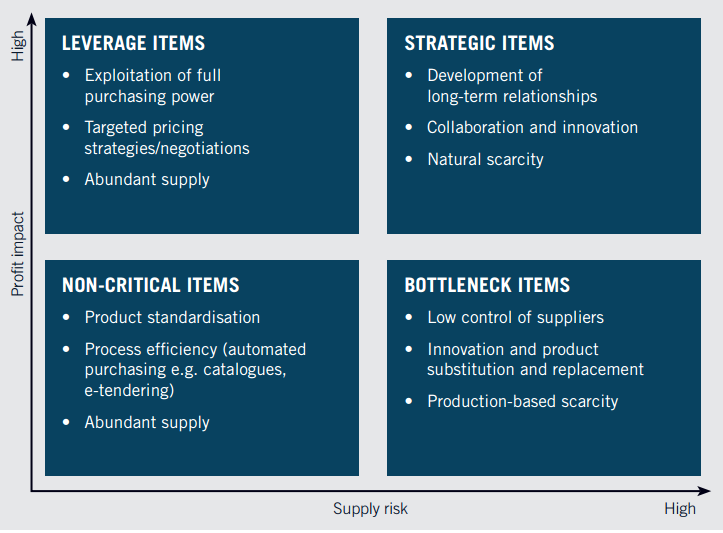
The Kraljic Matrix was created by Peter Kraljic in 1983 and it first appeared in the Harvard Business Review. Though it dates back over three decades, its relevance still remains. 

Kraljic, in 1983, devised a means to segment the supplier base. He argued that supply items should be mapped against two key dimensions, namely – supply risk and profitability

Supply risk is associated with the degree of difficulty while sourcing a product or a service. It is also associated with the vulnerability of the supplier to provide the product or service on time. 

Profitability is used to show the extent of the potential of the supply in contributing to the profit potential. This can be achieved by lowering costs by paying a lower price or by buying more efficiently. 

When you put the two key dimensions together, a classic two by two matrix is created – like in the image below. 

Source: Forbes and Peter Kraljic’s HBR article (1983) 

Each of these quadrants represents a unique buyer-supplier relationship type and suggests a distinct set of sourcing strategies. The matrix consists of the following:

  1. Non-critical items 
  2. Leverage items
  3. Bottleneck items
  4. Strategic items

As per the matrix above, non-critical items are low risk and have a low impact on organizational profitability. Items like office stationery fall under this category. 

Leverage items have high profitability but a low-risk factor. Buyers can obtain greater returns by leveraging their strength of possessing the balance of power in the relationship as suppliers can easily be substituted since their offerings are more or less the same. 

Bottleneck items are high-risk but the profitability is low. Suppliers have the strength since the market has fewer suppliers who can drive the prices of items upwards. 

Finally, strategic items are high supplier risk and high profitability and these are critical to the business. These suppliers need to be dealt with with absolute care as they are your strategic suppliers. 

In conclusion, Kraljic’s basic insight was to encourage the buyer community to be more intelligent while managing their resources. Also, companies that treat their strategic suppliers as non-critical and are taken for granted, have the potential to lose a good chunk of profit. 

How to Control Procurement Costs?

Digital procurement is all about controlling costs and managing the complex P2P process efficiently with minimum error. The procurement management software helps in automating the complex purchasing cycles which in turn helps in reducing and controlling costs. 

Developing a cost-saving strategy involves being up-to-date with the latest procurement technologies, maintaining good relationships with suppliers, etc. Procurement managers can optimize operational workflows and maximize their company’s profitability by being cost-efficient. 

Here are a few things your organization can do to control procurement costs:

  1. Avoid maverick spending.
  2. Identifying and assessing the right suppliers for long-term growth and stability.
  3. Develop and forge strong relationships with your strategic suppliers.
  4. Leverage the use of data.
  5. Be updated with the latest technologies in procurement.
  6. Automate the entire P2P process and save time and money. 
  7. Develop risk management tools and procedures and assess them at regular intervals.
  8. Have a centralized purchasing system that will prevent purchases from being duplicated and will reduce maverick spending.

If your organization can successfully implement a digital procurement management system, it will automatically curb costs and reduce the complexities in your procurement process. 

Implementing cost-saving strategies is crucial to every organization across all industries and having a procurement strategy that helps reduce costs and manage risks is the way to create a healthy financial foundation. 

How to Pick the Best Procurement Software?

A good procurement management software can open up a host of ways in which you can minimize costs and increase efficiencies. However, not all e-procurement solutions offer the same results and benefits. Hence, it is crucial that your organization invests in the right procurement management software to gain maximum results and profits. 

Here are a few things to look out for in digital procurement software that will help you with cost savings:

  1. Customer support
  2. Easy onboarding and implementation
  3. Risk management and vendor management capabilities
  4. Digitized audit trails which encourage transparency
  5. Invoice matching software which provides a 3-way match 
  6. Spend analytics and management reports 
  7. Budget tracking with real-time budget data 
  8. Efficient approval workflows
  9. Ease of use on a mobile device
  10. ERP and accounting software integrations
  11. Inventory management software which reminds you about the reorder value and time
  12. Level of customization as per your needs; flexibility of the software to adjust to your needs
  13. Incorporates the entire P2P cycle
  14. Budget management will ensure fraud detection and identify costly errors

Bellwether provides a free-to-download checklist where you can compare our software to your current software provider and weigh the benefits of working with us and how we can help your organization reduce costs and ensure profitability. 

As purchase managers, you need to analyze the procurement management software perfectly before choosing the right solution as this will set your company on a path to success in 2022. Bellwether can help you on this journey! 

source https://www.bellwethercorp.com/the-complete-handbook-for-purchasing-managers-to-succeed-in-2022/

The Complete Guide to Strategic Procurement

Developing a procurement strategy that effectively encompasses productivity, efficiency, agility, and automation is a tricky task. A task, if achieved, can take the current procurement landscape to new levels of effectiveness and growth. 

Let’s understand what strategic procurement is and how implementing a proactive approach to procurement can help in efficient spend tracking and much more. 

What is Strategic Procurement? 

The term Strategic Procurement refers to the company-wide process which aims to ensure the timely supply of goods and services in line with the long-term strategic/business goals of the organization. 

Strategic procurement is critical for an organization to meet its core objectives while reducing the risk within the supply chain and maintaining long-term relationships with suppliers. Since this aligns with the company’s business goals, it is an activity that requires cooperation from all departments throughout the organization. 

Why Strategic Procurement?

Company-wide goal-setting and strategy for procurement are not just about reducing costs, it is about achieving effectiveness across a range of values and standards that matter to your enterprise.

Having an inconsistent procurement process throughout the business is a pain point for many organizations. This is due to a lack of planning and inconsistency within the departments.

Strategic procurement helps companies bypass common mistakes like undefined purchasing tasks, lack of efficiency and balance in the procurement process, and much more. Procurement alone cannot help a company march on the path of success if it is not in line with the core objectives. 

Hence, implementing strategic procurement at the highest level will not only help the company’s growth pace but also maximize bottom-line profits. 

A dedicated team can aid in setting the right direction for the business by skimming through past procurement processes’ data and implementing future procurement plans. 

Procurement v/s Purchasing

The terms procurement and purchasing are often thought of as the same and are used interchangeably. However, they are quite distinct in their intent, what they accomplish and the people involved. 

The procurement process includes identifying a need, researching suppliers, and then sourcing them after careful selection and consideration, issuing RFQ, and evaluating quotes. Further, it also includes negotiating, acquiring goods and services, quality checks, analyzing KPIs, and building long-term supplier relationships. 

The above-mentioned points are a glimpse at how the end-to-end procurement process looks like. But what is purchasing? 

Simply put, purchasing is a tiny subset of the broader procurement function. Purchasing is associated with acquiring the goods and services required by an organization. Activities like ordering, processing payments to suppliers, receiving, and payment fulfillment are associated with purchasing. 

The procurement process starts right from the identification of needs while the purchasing process starts with obtaining a purchase requisition, which comes much later in the procurement process. Procurement is a much broader term while purchasing is a small part of the larger procurement process. 

Types of Strategic Procurement

Procurement has evolved and there are types of procurement that are much talked about lately. Let’s have a look at some of them.

Strategic Sourcing

Globalization has forced businesses to go digital. Most businesses today take what is the best from globalization for them in order to expand performance and enhance efficiencies. Hence, the role of effectively sourcing goods and services from suppliers has become inevitable. 

In the changing business landscape, procurement is transforming into a more strategic function that is aligned to business objectives and long-term goals. The current COVID-19 crisis, economic volatility, and technological disruptions have rendered the market fierce competition. Therefore, businesses need to adapt to these changes and this is where strategic sourcing comes into the picture. 

Strategic sourcing is the process of identifying the spend profile of an organization and its supplier base to make sure their business requirements are aligned with the suppliers. Successful implementation of a strategic sourcing process creates efficiencies across spend categories, minimizes supply risks with improved supplier selection, and gives visibility into pricing and forecasting. 

The aim of strategic sourcing is to minimize the risks involved in the supply chain while continuously evaluating and re-evaluating the sourcing activities in the organization. Strategic sourcing considers suppliers as critical value partners and aims to build sustained and collaborative relations. 

Understanding the company’s suppliers is an important aspect of strategic sourcing and involves immense research. It is crucial that an in-depth understanding of the suppliers and their core capabilities is developed and aligned to the sourcing requirements of the organization. 

Since there is so much time spent on selecting the suppliers, businesses can achieve optimal efficiencies in both customer and supplier organizations. The three most important components of strategic sourcing include spend analysis, researching the market, and evaluating the suppliers i.e. supplier relationship management. 

While each of the above components requires close attention, flawless execution of these components takes a talented human resource team with specific skill sets and an efficient ERP technology to achieve desired results. 

Tactical Sourcing

While strategic sourcing had everything to do with the long-term goals and core objectives of the company, tactical sourcing is more of a short-term approach. This type of sourcing is commonly practiced in small to medium-sized manufacturing organizations. 

Tactical sourcing essentially focuses on achieving the lowest possible cost without considering other factors like supplier relationship management, risk management, supply chain risk mitigation, etc. As a result, building long-term relationships with suppliers and understanding how it aligns with the company’s core objectives is not a priority in tactical sourcing. 

This type of sourcing is not considered to be sustainable as it does not factor in the long-term objectives of an organization and communication with suppliers happens only when a problem arises. It is said that tactical sourcing can bring short-term gains to a company but it prohibits sustained optimization of its sourcing activities. 

Operational Procurement

Just as the name suggests, operational procurement is the procurement of goods and services that are required for the daily sustenance of a business. It is also referred to as MRO purchasing i.e. maintenance, repair, and operations. These purchases are necessary to keep the business running. 

This type of procurement is most effective in larger companies as they will benefit from applying operational procurement principles to their overall procurement process. The larger the company, the more the benefits. 

Operational procurement aids in keeping the production run smoothly. It is about optimizing procurement functions so that the company has access to the materials they need at the right time, place, and at the best possible price. 

This type of procurement gives way to optimal cost savings in a number of ways. Since procuring goods and services for the daily functioning of business is complex, there is room for error and maverick spending. However, with operational procurement, you will see improved reporting as you can extract data from your systems. 

These reports can be shared within your organization with stakeholders, they can generate key performance reports, etc. which in turn will leave less room for error and maverick spending. 

While procurement has evolved over time and the landscape is ever-changing, it is safe to say that the above-mentioned types of procurement are useful for any kind of business to build a stronghold in their industry. Optimizing efficiencies, aligning to long-term goals, reducing costs, and making time to do the more important things in an organization is the way to go!

Now, let’s have a look at the steps involved in strategic procurement. 

The Steps of Strategic Procurement

The procurement process is not always easy. It can get rather complicated. Implementation of the strategic procurement process is organization-wide, keeping in mind the long-term goals of the company. It requires the cooperation of all the departments in an organization for successful implementation. 

Simply put, if all the departments are on the same page about the strategic procurement process, it is easier to implement the plans and set up a team for the same. This team will set the overall direction for procurement, aligned with the company’s business strategy. Further, the team will then use the data from the strategic procurement process to develop and implement a strategic procurement plan. 

Here are the steps to a successful procurement process:

  1. Internal need analysis

Before developing any strategy, it is crucial that we do need analysis. In the same way, a procurement strategy demands the identification of needs and targets which involves the collection of several types of data. This helps with current growth projections and maximizing cost savings. 

  1. Spend analysis 

There is nothing more important than to analyze existing spend by sourcing data from suppliers as well as from within the organization. 

  1. Assessment of the supplier’s market and supplier selection

Conducting a thorough analysis of the suppliers’ market and researching about them is an essential step that can set your organization up for success. The selection of suppliers should be done carefully as the supplier’s inability to meet selection criteria can result in significant losses for the company. 

  1. Create a procurement/sourcing strategy and implement it

Based on the information gathered above, a company can make informed decisions and can proceed to develop an efficient sourcing strategy. Once you have a strategy in place, the successful implementation of your sourcing strategy should not be a problem.  

  1. Negotiation with suppliers and selection of winning bids

The strategic procurement team evaluates the responses gathered from suppliers and after making an informed decision, will select the winning bid and award it to the supplier. Once the evaluation process is complete, the team will enter contract negotiations with the first selected bidder. 

If the above steps are followed, your organization will have successfully developed and implemented a strategic procurement plan. 

Best Strategic Procurement Tools

While we read all about what strategic procurement is and why it is important for your organization to implement a procurement strategy, it is important that you also know the best tools to use which will help you implement the strategies. 

Here are a few procurement tools that will help your organization nail the strategic procurement process:

  1. Coupa

Coupa’s cloud platform will help you manage all your transactions across procurement, payments, and supply chain. Coupa’s procurement software is slightly on the expensive side and is only for enterprises. 

  1. Bellwether 

Bellwether is among the initial leaders and has been in the procurement industry for over 35 years. Bellwether’s procurement software has the capability to give your organization greater visibility and control of your company’s spending by cutting costs and streamlining purchasing. This procurement software has different products for SMBs and enterprises with reasonable pricing. 

  1. SAP Ariba 

SAP Ariba’s e-procurement and supply chain cloud solutions are easy to deploy and have helped many companies realize value and save money. Ariba’s procurement software is slightly on the expensive side and is only for enterprises. 

  1. Procurify 

Procurify has a centralized purchasing management software with custom approvals, budget controls, and real-time insights with an intuitive and user-friendly solution. This is a good solution that is a little expensive but lacks important procurement features like inventory.  

  1. Oracle Procurement Cloud

Oracle’s cloud procurement software’s capabilities, built-in collaboration, and analytic insights drive agility, manage risks and increase margins. This is a great software which is slightly expensive with prices above $500/user/month.

After evaluating your organization’s needs and budgets, you can make an informed decision about which is the right procurement software for your company. The implementation of procurement in your organization will only bring positive changes to your bottom line and help in reducing costs and managing time efficiently. 

Procurement Tips for Purchase Managers

Purchasing managers are a crucial part of a company and they are important for the smooth functioning of the procurement process. They play an important role in the success and failure of the companies they work for. 

In short, procurement managers are expected to forecast anticipated demand for products and services and when they are not doing this, they spend time negotiating with suppliers and vendors to get the most value for their company. 

They are also responsible for nurturing a long-lasting relationship with suppliers, forecasting price trends, managing their own teams and training them, among many other things. Now, these are all very important tasks and they are not all easy. 

To top all of the above, the procurement landscape is ever-changing, thanks to the COVID-19 pandemic, and purchase managers have been striving hard to keep their supply chains and procurement processes from falling apart. 

To tackle the recent crises and many others to come, purchasing managers need to take their procurement and managerial skills to the next level. Here’s how: 

  1. Innovation in procurement 

Managing your purchasing process can be made easier if you adapt to the latest technologies which help your businesses grow. Using tools that help you manage your teams better while not losing focus on the bigger picture can help you a great deal. 

  1. Forging strong and long-lasting bonds with suppliers

Your role as the purchasing manager will be more effective when you have good relationships with your stakeholders i.e. your suppliers and vendors. Sharpening your vendor management skills can help you win them over, resulting in better business. 

  1. Collaboration with teams 

Your team is the most critical aspect of managing your procurement processes. If your team is not in sync, there are chances that the process may collapse. In today’s remote work cultures, it is crucial that there is a collaboration between teams. 

  1. Empowering top performers to keep them engaged

The happier your team’s top performers, the more likely they are to perform better. Rewarding your team members’ achievements will only make your job of managing them easier and make the team more efficient. 

  1. Looking and thinking beyond the best 

Finally, it is important that procurement managers look at their end goal. If every manager did things like everyone else, what will make them stand out tall from the crowd? Thinking beyond the usual will definitely help managers to grow. 

source https://www.bellwethercorp.com/the-complete-guide-to-strategic-procurement/

Why Procurement Software is a Valuable Investment for SMBs

In the digital world, it’s surprising to see just how many businesses are still using manual procurement processes. Organizations across the world are still using spreadsheets that are time-consuming, error-prone, expensive and inefficient. The solution to these woes is in the utilization of procurement software.

Is Your Manual Procurement Process Hurting Your Business?

Manual processes are holding businesses back and costing them in a way they often don’t realize.

Lost Hours

Tracking down vendor information in email chains or through multiple spreadsheets, reviewing contracts, and manual sourcing all take a toll on the efficiency of employees and the procurement department as a whole. To solve these issues, organizations can leverage e-procurement software that automates time-consuming tasks and creates a centralized location for purchasing decisions.

Messy Documentation

Too many files and too much paper can result in messy documentation. When contracts are stored in hard copy or PDF, it’s difficult to access the details of the contract, including negotiated terms and conditions. The result is far too much time spent looking for documents, or the info and details within those documents.

Investing in procurement software solutions means no more hard copies and no more PDFs of important information. Instead, everything is stored in one place, making it easy to find, exactly when you need it.

Missed Savings Opportunities

When you speed up tasks like creating invoices and vendor selection, you can make faster and more valuable decisions. Automating processes means that your staff can focus their energy on other tasks, such as building beneficial vendor relationships.

No Centralized Location

When you use a manual procurement process, you don’t have a go-to source of data and information. Without this location for information about suppliers, the purchasing department must go through various internal and external sources to find the information they need.

Decentralized tools mean that the staff doesn’t have a whole lot of visibility into the procurement process, which can lead to savings leakage and risk. Often, the details get overlooked, and communication begins to break down between the procurement team and customers or suppliers.

With purchase order software for small businesses, you can more easily store and find information in one easy to use platform.

Inefficiency

When you get down to it, a manual process isn’t efficient. When a part of your business is inefficient, your business itself is not as efficient as it could be. Inefficiency leads to your business losing money. For every simple task that ends up taking tons of time out of your employee’s day, your business is losing money.

You can avoid losing money when you automate the procurement process with online procurement management software that allows anyone involved in the procurement function to easily and quickly find the information they need.

Why Invest In Procurement Software?

Depending on your business needs, investing in procurement software is a big decision. Many businesses believe that manual processes are cheaper, but when it comes down to how much time is being wasted, that assumption just simply isn’t true.

Now that you know the risks of continuing to use a manual, spreadsheet-based procurement process, let’s discuss the advantages of procure to pay software for small businesses.

Eliminate Paper-based Systems

Paper-based systems are time-consuming and can lead to confusion. Purchase order software creates electronic purchase orders with all of the necessary information automatically. Those purchase orders are then accessible in real-time from anywhere when using a smartphone or computer.

Purchasing Based on Your Policies

The automation of a cloud-based procurement solution makes it easy for you to create hierarchies and rule-driven workflows to ensure your purchase orders are accurate and comply with your (and your vendor’s) policies.

Boosts Productivity

With less busywork comes productivity. Task automation requires little to no human intervention and provides routes and alerts for approval workflows, automatic collection, and cross-referencing of transaction data. By boosting productivity, you can free up time for your employees to focus on more important tasks.

Fewer Errors

With a pre-selected vendor list and integrated inventory and contract management, procurement solutions make compliance easier. There will be no more duplicate orders or invisible spend.

Efficiency

Automated procurement platforms boost purchase order processing speed and improving workflows. The purchasing process that may have taken days will now be condensed into just a few hours.

Cost Savings

Streamlining the purchasing process results in significant cost savings. Less time and fewer resources required for procurement mean that you can save money and spend it in other areas of your business.

Actionable Data

Actionable data is stored securely on the cloud for easy analysis. You can quickly gain insights into the potential issues in your workflows, create financial reports and budgets, and even identify areas of potential in your supply chain.

Spend Management

E-procurement solutions structure spend across vendors and provides detailed tracing information. This spend management allows you to track cost reductions continuously and identify gaps.

Integration

Purchase order software integrates with your accounting software to create purchase orders and invoices with just a few clicks of a button.

Bellwether: A Valuable Investment for SMBs

You can harness your business’ potential by using automation to increase the efficiency of your procurement process. By integrating a purchase order system that meets all of your business needs, you can expect higher levels of productivity, efficiency, and a better bottom-line than ever before.

Bellwether’s solutions mean that your procurement department will never drop the ball again, lose valuable paperwork, or get lost in the mess of manual operation. Instead, use the time saved to invest in building relationships that can result in even more cost savings.

Discover exactly how (and how much) Bellwether can save your business money with our new procurement ROI calculator.

Contact us today to learn how automation is the key to the success of your procurement function.

The post Why Procurement Software is a Valuable Investment for SMBs appeared first on .

source https://www.bellwethercorp.com/why-procurement-software-is-a-valuable-investment-for-smbs/

Change Your Spreadsheets With Cloud-Based Purchase Order Software

Many small businesses begin their procurement journey using manual processes. This includes using spreadsheets to manage their entire procurement process. While this may work originally, as your organization begins to grow, you’ll probably find yourself spending too much valuable time and money handling the procurement process manually.

Changing your spreadsheet-based procurement process might be right for you if:

  • You found an invoice and then got an email saying that it wasn’t approved by the finance department.
  • Orders keep getting lost because a critical document was misplaced. 
  • You continuously spend valuable time correcting human errors that could have easily been avoided.

Lucky, there is a solution: cloud-based purchase order software.

Signs That Manual Procurement is Failing You

If you don’t know whether it’s time to make the change to more automated procurement processes, check out these signs that your procurement process is failing your business.

No Transparency

Spreadsheets are a great tool for organizing data, but when you need to use more and more spreadsheets to manage your data, your system starts to break down. You may have problems accessing data, organizing, finding information, and tracking it through multiple spreadsheets.

When the amount of data you need increases over time – which it does with every successful business – you reach a point where you’re simply unable to retrieve and track valuable information in the same amount of time. You also have to deal with security concerns and keeping information private.

Human error can also lead to inaccurate information, which can cost you deals, customers, and relationships with your suppliers. It can also affect your profits.

Businesses need transparency when it comes to their data. They need the ability to store, record, and find data, which can be difficult when using multiple spreadsheets. At the very least, you cost your business valuable time and money digging through files trying to find required information.

Investing in a web-based purchase order system is not a luxury for big businesses; it’s a necessity for successful businesses.

Policy Compliance

Your business has guidelines, especially within the procurement department, which will need to spend the most resources. When these guidelines aren’t followed, your purchasing function falls flat.

Inconsistency is very common with businesses who use manual processes. One employee may follow your organization’s policies when it comes to vendor relationships, but another employee may not. While focusing on individual tasks, employees lose sight of the big picture of procurement, which is efficiency, productivity, and financial goals.

When your employees use procurement software, there is only one way to do things: using the software to increase efficiency and productivity, ultimately saving your business time and money.

No Clarity

Manual procurement processes lack clarity. Each member of the procurement department is likely to make small errors or poor purchasing decisions. For example, if a procurement staff member makes a purchase that doesn’t require approval, it’s possible that another staff member already made that purchase order and sent it. Whether or not the financial department catches this mistake in time, you can expect time taken out of everyone’s day to resolve the issue.

Using an online PO system eliminates these risks and provides clarity for all of those involved in the procurement process. With real-time data, role-based permissions, and data accessibility, you can expect a more efficient procurement department.

Unsatisfied Customers and Vendors

An overly-complicated procurement strategy can affect relationships with both your customers and your vendors. You can expect missed deadlines, lost invoices, and many other mistakes to be made when you have everyone working with manual processes that aren’t centrally located.

Consider a lost invoice. If this happens, your vendor is not likely to want to continue working with you, or they will no longer follow the terms of their contract. Remember, the contract involves your business as well. Not paying an invoice on time could result in a breach of contract that will destroy your relationship with a vendor.

Your customers can also get caught up in this mess when you don’t have items in stock. Your customers rely on you to make sure you can fulfill orders and keep them happy. When this isn’t done, you can bet that those customers won’t be returning.

Automated purchasing systems allow you to keep track of everything that you need to without the hassle and mess of manual spreadsheets. Not to mention, it will be easier to ensure fluidity for your customers and vendors, which makes everyone happy.

Automating Your Procurement Process

Automation can drastically improve the procurement process of your organization.

Documentation

Instead of digging through printed files or searching through computerized spreadsheets, you can access your data easily and instantly.

Boosts Productivity

Online purchase order systems take care of the executions of the procurement system. That means that your employees can spend time on tasks that involve human interaction, such as building and maintaining supplier relationships.

Eliminate Human Error

E-procurement solutions have features like three-way invoice matching that help eliminate the potential for human error. Once the purchase order is created, purchasing software automatically creates an invoice with all of the correct data.

Policy Compliance

Procurement solutions ensure that tasks are completed based on your organization’s procurement policies and any government regulations.

Actionable Insights

Purchasing software provides you with all of the data that you need to make business decisions.

Automate Your Procurement Process with Bellwether

Join the thousands of businesses who are making the switch from spreadsheet-based purchasing processes to online purchase order management software. With increased automation, you can increase your bottom line, boost productivity, and save money simultaneously.

Wondering how much money you can save with procurement software? Calculate your procurement ROI now and uncover the benefits right now.

There’s no need for all of the stress that potential human error can cause. Consider all of the money that you are wasting spending time on processes that can be automated and more efficient. Your business deserves a procurement process that will take it to the next level.

Contact Bellwether and start saving today.

The post Change Your Spreadsheets With Cloud-Based Purchase Order Software appeared first on .

source https://www.bellwethercorp.com/change-your-spreadsheets-with-cloud-based-purchase-order-software/

Best Purchasing and Inventory Management Solution that Syncs With Quickbooks

If you run a small business, you’re probably using QuickBooks accounting software – at least in some capacity – to keep track of your finances. You may know that QuickBooks, no matter which version you are using, has a basic purchase order system that lets you create and track your purchase orders. While this feature is extremely helpful and convenient, you’ll see that as your business grows, so does your need for a more robust purchasing system.

What many businesses really need is powerful purchasing and inventory software that allows them to handle the procurement process in a single, easy-to-use platform. When you integrate Bellwether with Quickbooks, you can expect more efficient purchase order management and customizable approval workflows that streamline all aspects of the purchasing function.

What QuickBooks Can Do

No matter which version of QuickBooks you are using, you are able to:

  • Create Purchase Orders
  • Enter Vendor Invoices
  • Track Stock Items

While this may be enough for a business just starting out or for specific business models, it does not create an efficient purchasing function for small businesses with broad inventories, or for those who plan to grow and require more powerful purchasing and inventory functions. 

What QuickBooks Can’t Do

Inventory Control

QuickBooks offers a basic inventory tracking function, however, it is not as robust as many businesses need. At the basic level, tracking your inventory can actually cost your business valuable time and money.

Bellwether’s software syncs with QuickBooks to track inventory across multiple warehouses and locations. This allows you to run your operations in less time and eliminate costly errors, which improves your inventory process, lowers your overall costs, and increases your profits.

Bellwether inventory management software extends the basic accounting features of Quickbooks to give users the ability to synchronize inventory items, vendors, purchase orders, and invoices.

Controlling Your Spend

Maverick spending gets a lot of businesses in trouble. Often times, the procurement department is using manual processes to keep track of their inventory, which can lead to items being checked out and not reported or mysteriously going missing. This can lead to unnecessary spending and bad purchasing decisions because the purchasing department simply doesn’t know what they do and do not have in stock.

By syncing QuickBooks and Bellwether, it’s easier to understand your inventory and know what you need to order and when. You can even plan for the future and uncover how often certain items need to be reordered.

Invoice Matching

When you create a purchase order, you need the ability to create an invoice with the exact same information. This process can be time-consuming and unnecessary with the use of purchasing software for small businesses. By syncing Bellwether with QuickBooks purchase order software, you can match invoices against purchase orders and delivery slips to ensure the accuracy of your invoice processing.

Unnoticed mistakes happen all the time in a fast-paced, busy office, especially when documentation isn’t properly cross-checked, such as invoices and purchase orders to ensure proper pricing, and the correct number of items. Never let mistakes go unnoticed again – start using a better procurement function that allows your staff to quickly and easily check delivery slips, invoices, and purchase orders. Minimize mistakes and losses while maximizing gains.

Eliminate Manual Processes

When you first started your business, the manual processes you used may have been effective enough. However, you’ve most likely realized that you are spending too much time searching for the correct documentation, or creating purchase orders and invoices that match.

With Bellwether’s cloud-based procurement software, you can create purchase orders in QuickBooks and store all of your data and documents in one system. You can then access your data quickly and easily from virtually anywhere using a computer or smartphone.

Eliminating paper or spreadsheet-based processes will allow you to handle the procurement function more easily and eliminates the potential for human error. If you like paper documents, you can always print out your procurement records for your own safekeeping as well.

Approval Workflow

In most businesses, purchases need to be approved based on funds. Often, that means sending a request for a purchase order to the finance department and waiting for approval. This is typically where a breakdown in workflow occurs.

Instead of waiting for someone to approve the workflow when you are using just the QuickBooks purchase order feature, Bellwether allows you to set criteria for approvals based on a specific budget. From there, the procurement staff can create a purchase order inside QuickBooks for which the items have already been approved and send it to the supplier. This reduces time, and improves the overall workflow and order efficiency.

Manage Supplier Contracts

While in QuickBooks, you can view the prices and certain information on the purchase order, but you cannot view the supplier contracts. These contracts are important for any business as they lay out the terms that the supplier must follow in regards to quality, delivery, and quantity.

As you know, when a supplier doesn’t follow the terms of their contract, your business is put in a sticky situation that can end up costing you even more time and money. Bellwether allows you to match invoices with purchase orders and manage supplier contracts easily so that you know exactly which vendors are the best for your business.

Vendor Catalogue

The purchasing process is much easier when you have the items you wish to purchase right in front of you. You will typically receive catalogs from vendors that list their products and details. Businesses using manual processes will need to store these catalogs for future use. QuickBooks does not offer a feature for inputting information from catalogs for you to see and find more easily in the future.

However, with Bellwether, you can store vendor catalogs for easy access in the future. From there, you can search for specific vendors or items and create a purchase order in QuickBooks using the information that has already stored.

Bellwether’s Seamless Integration with QuickBooks

Bellwether fits into your current workflow by integrating with the software you already use. Automation is key to the success of your purchase order process.

QuickBooks offers a few automations to help make your purchasing process more efficient. However, when it comes to the greater process of procurement, you need software that can do everything in one simple and easy to use interface. Remember, QuickBooks is accounting software, not procurement software.

Businesses are rapidly realizing that manual processes and spreadsheets are not efficient or effective enough for maintaining a successful organization, or optimizing profits.

To learn more about how procurement software can increase the efficiency of your business and save you money, contact Bellwether today.

The post Best Purchasing and Inventory Management Solution that Syncs With Quickbooks appeared first on .

source https://www.bellwethercorp.com/best-purchasing-and-inventory-management-solution-that-syncs-with-quickbooks/

How Real-Time Data Revolutionize Your Organization’s Purchasing Experience

Organizations are quickly realizing that real-time data is the key to success. It can help enhance the customer experience and provide valuable insights for businesses. Real-time data can also transform a business’ purchasing experience, making it more efficient and more effective, and helping to reduce costs. Using e-procurement software, you can maximize productivity and minimize losses using data. Here’s how real-time data can be used to benefit your organization’s purchasing process.

One Marketplace

With procurement management software, you can upload catalogs in one place so that you can compare prices and get the best bang for your buck. All you have to do is use the data that is punched in so that the software can comparison shop all of the options available from your network of suppliers. All of this information is then shown to you in one area. Your suppliers will not need to make any investments of their own to be connected to you. Also, your employees will no longer need to search through physical catalogs to price compare.

Real-time data can also integrate product descriptions and data from online search results. This data will give up to the minute price options so that you can compare recent prices without the need to contact your suppliers directly.

Securing the Best Deals

Real-time data can drive savings by securing the best deals for your business. It tracks your organization’s purchase history and supplies useful analytics to determine the competitiveness of current negotiated supplier pricing in comparison with competitors. This information is provided up to the minute in comprehensive reports so that you have actionable information that allows you to better negotiate with suppliers.

Validate Negotiations

Discounted prices should be reflected at the time of purchase to make a well-negotiated contract. Your team works hard to negotiate agreements and terms with suppliers, but it is often challenging to ensure that they are compliant. Expensive and time-consuming audits are done to identify and recapture any transactional errors that may have occurred that are a breach of contract. This not only delays orders but requires manual interventions and reorders.

Real-time data lets users discover off-contract pricing and products before the process immediately so that you don’t pay for something that is wrong. You won’t need an expensive, drawn-out audit to discover discrepancies anymore.

Supplier Relationship Management

When you have advanced, real-time capabilities, your sales channel becomes more attractive to suppliers. Your employees will be able to browse and search catalogs and websites much more easily and from one private marketplace. As user purchasing increases through that marketplace, the supplier sales will increase. This will lead to contract negotiations that benefit both your procurement process and the suppliers to create a truly mutually beneficial relationship that will drive cost savings.

Remember, your supplier relationship goes both ways. Your procurement process affects them, too. If your supplier ships an order and doesn’t receive payment, you will damage a crucial relationship. People in the same industry talk, so protecting your reputation is essential.

Compliance is another major factor when it comes to these relationships. Both parties must follow the terms in the contract. Data will help you determine whether or not you are complying with their terms to make sure the relationship isn’t one-sided.

By making your process more efficient with data, you can quickly and effectively manage the relationships that your success depends on. 

Automation

Real-time price validation of items before an order transaction is complete will remove the potential order issues downstream in the procure to pay process. This will increase the speed of processing and reduce manual labor costs. Automation will take repetitive tasks and do them in real-time to help employees focus on more time-consuming tasks. The data is also used to reduce any human error that can happen when you are using manual processes. The wrong number can cost your business.

Your real-time purchase system will use prices from the catalogs and input them into PO’s for you so that you don’t run the risk of losing money.

Refining the Procurement Process

Real-time data will allow you to refine your procurement process. If you are using manual methods, such as spreadsheets, you will see a drastic improvement across your operation. You will also be able to see analytics that show you which areas need improvement. You can first look at which part of the process takes the most time and find out why. Maybe the approval process is holding your business up. However, with real-time data, you can automate your approval process so that you’re not waiting for one busy person. Make sure to talk to everyone involved in the procurement process to find out which areas need improvement.

Once you have refined your process, make sure to share it with all of the employees involved in procurement so that they can change the way they do their job.

Your ROI

Let’s be honest. The most significant benefit your company will see is cost savings. Efficiency means that more work is getting done in a single workday, helping you save money each day you utilize real-time data.

You may think that using your cheaper, manual processes is the most inexpensive way to run your business. However, that simply isn’t true. Both free and more robust procurement software can help your employees save time and in turn, help your business save money.

SMBs can all benefit from e-procurement software no matter how robust it is because they simply automate your processes and increase your workflows to provide a simpler, more efficient purchasing experience.

source https://www.bellwethercorp.com/how-real-time-data-revolutionize-your-organizations-purchasing-experience/